

Offline mobile apps
Field agents enter data at source, on the plantation, without waiting for a network.
Impact: no more lost paper forms or re-entry.

Eleven areas of expertise, from consulting to artificial intelligence, under one partner.
Our priority sector: mapping, traceability, EUDR compliance and AI for agricultural value chains.
Our agricultural traceability and EUDR compliance platform, from plot to export.
Agriculture is our speciality, not our limit: nine sectors covered.
Every technology on the market, chosen for your context, not for a vendor.
Open the Technologies pageGuides and analysis to help you make informed decisions.
An African technology company, based in Abidjan and grounded in the field.
Free assessment: a 45-minute conversation, by video call or in Abidjan. Reply within 24 business hours.
Mapping, satellite imagery, traceability, mobile money payments: we design, build and deploy digital tools for agricultural value chains, for the producers, cooperatives, exporters and buyers who source in Africa.
Eight technologies we put to work for agricultural value chains, and what they can deliver in practice.
Field agents enter data at source, on the plantation, without waiting for a network.
Impact: no more lost paper forms or re-entry.
Each plot is delineated, measured and linked to its producer on a map.
Impact: actual plot areas and a well-managed supply base.
Monitoring of forest cover, crop condition and land-use change.
Impact: a way to check remotely for deforestation, in support of your due diligence.
Risk analysis, yield estimation, detection of anomalies in the data.
Impact: signals to help prepare the season.
Local weather, soil moisture and storage conditions measured continuously.
Impact: fewer post-harvest losses, better quality.
QR codes, secure registries and volume reconciliation, from the producer to the port.
Impact: every bag linked to its origin.
Traceable payments, premiums paid without cash, histories that can be used for credit.
Impact: traceable payments, with no need to transport cash.
Advice, prices and alerts sent to producers by SMS or WhatsApp.
Impact: the right practices at the right time.
An end-to-end architecture, designed to work where the network ends.
Producer record and polygon captured in the field, with no network.
Data sent as soon as the phone has a signal.
Duplicates, inconsistent polygons and outliers detected.
Dashboards by cooperative, area and season.
Reports for buyers, certification bodies and donors.
Each area can be a project in its own right or part of a complete system, designed for your organisation.
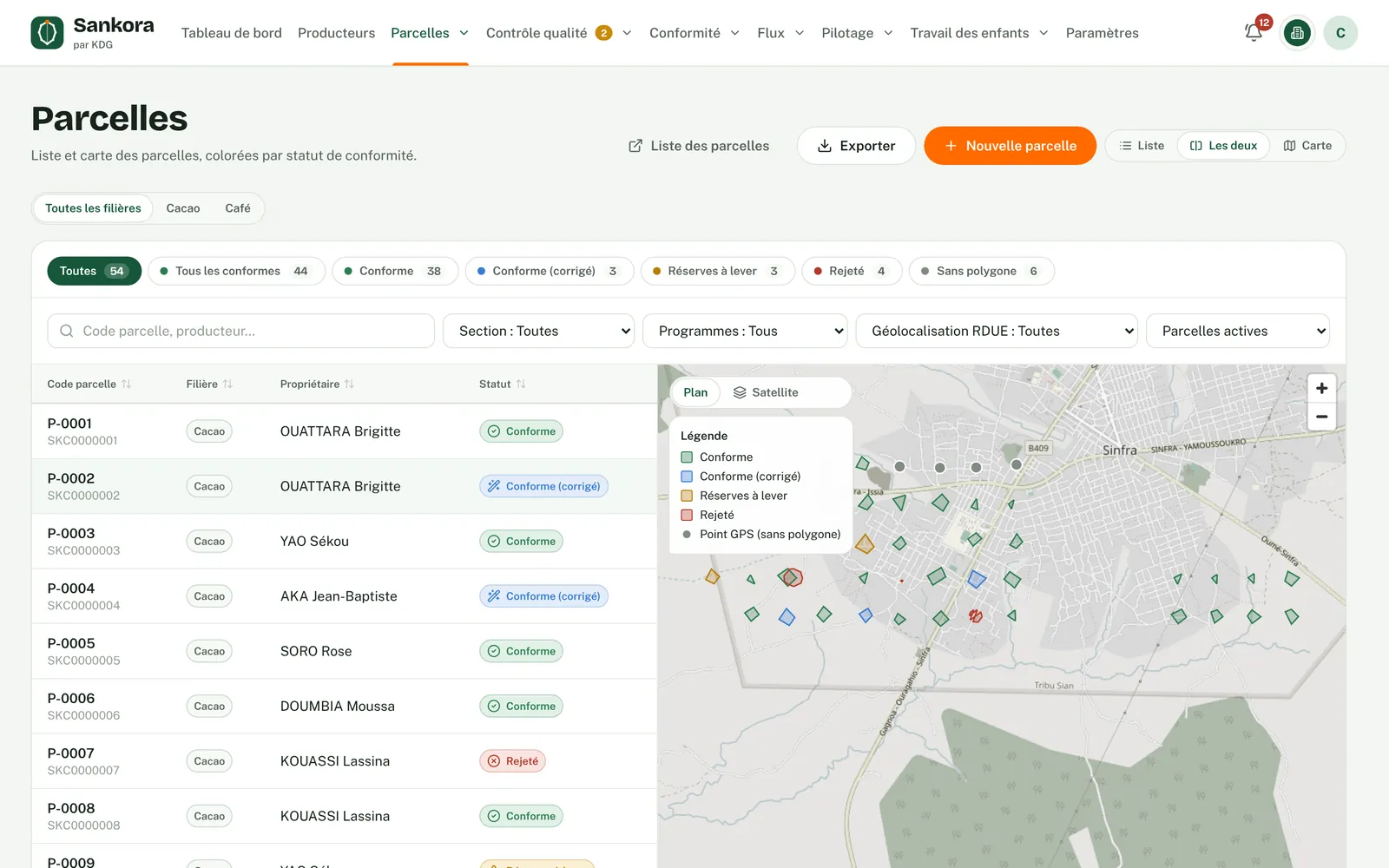
Field agents survey the boundaries of each plantation by GPS, in a data collection app that works offline. Areas are calculated automatically and each plot is linked to its producer.
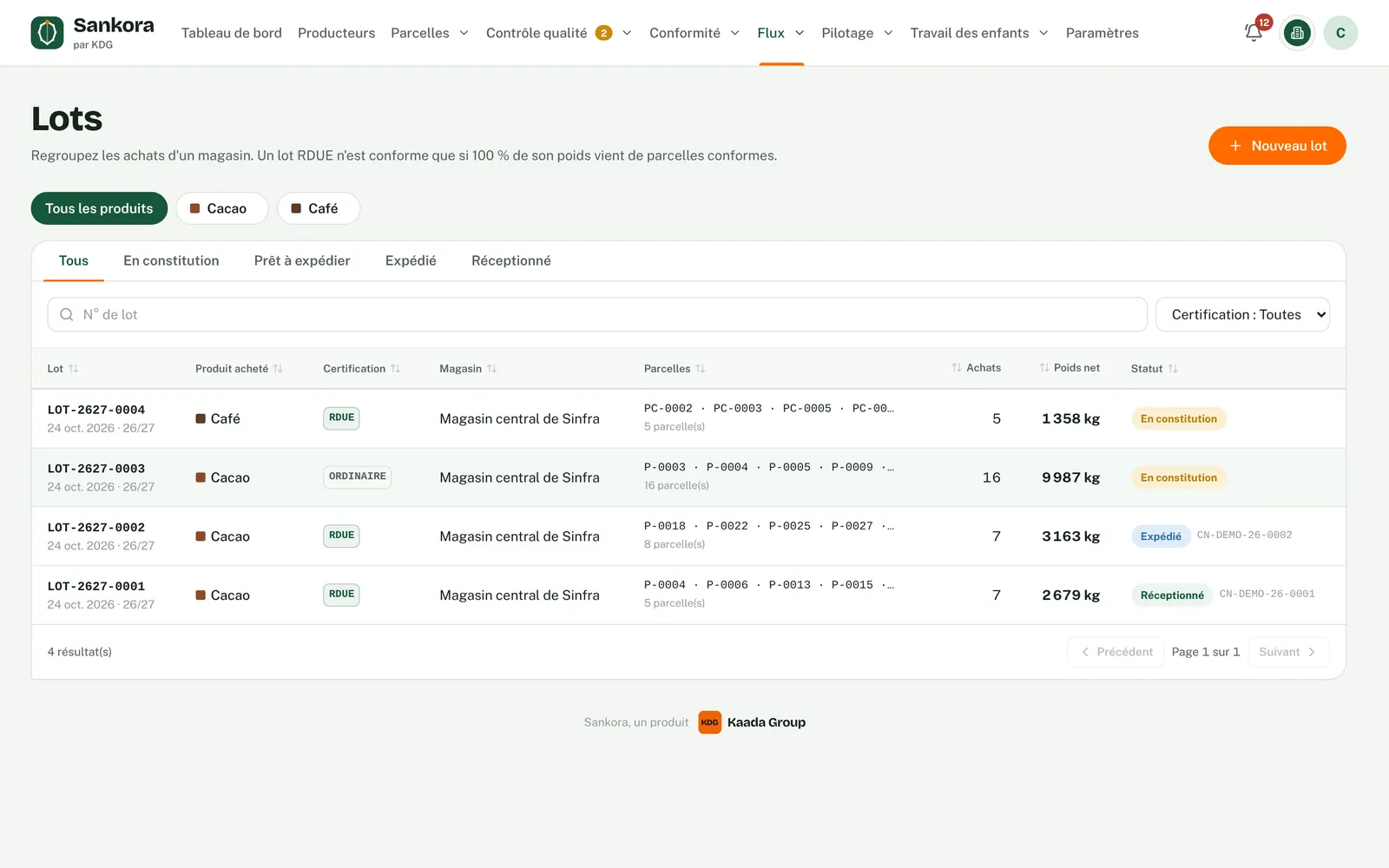
From the producer to the cooperative, then to the warehouse and the port, every transaction is recorded. A QR code per bag or per lot makes it possible to trace back to the origin.
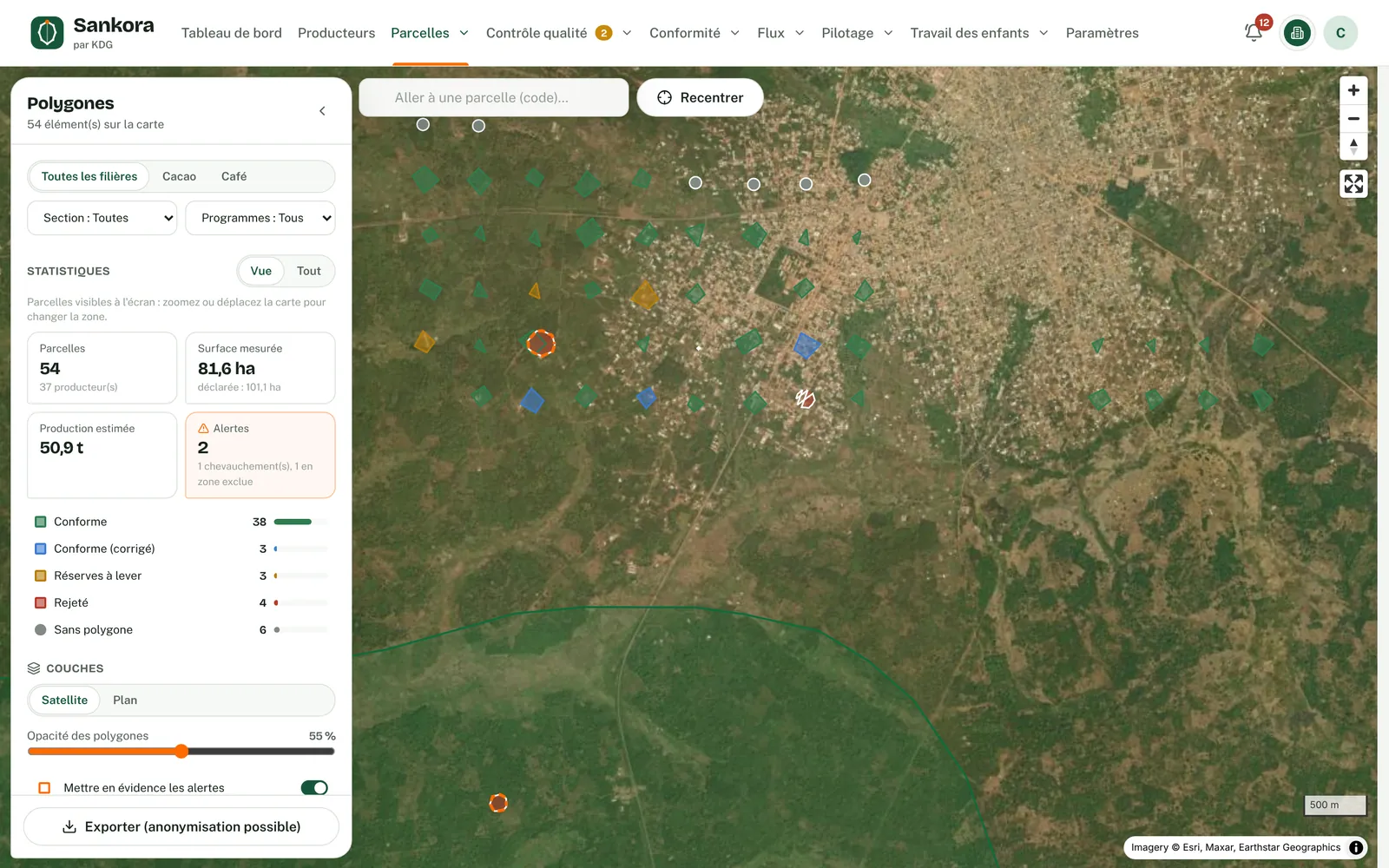
We turn your field data into a complete and consistent compliance file: deforestation risk analysis, volume consistency, audit-ready documents.
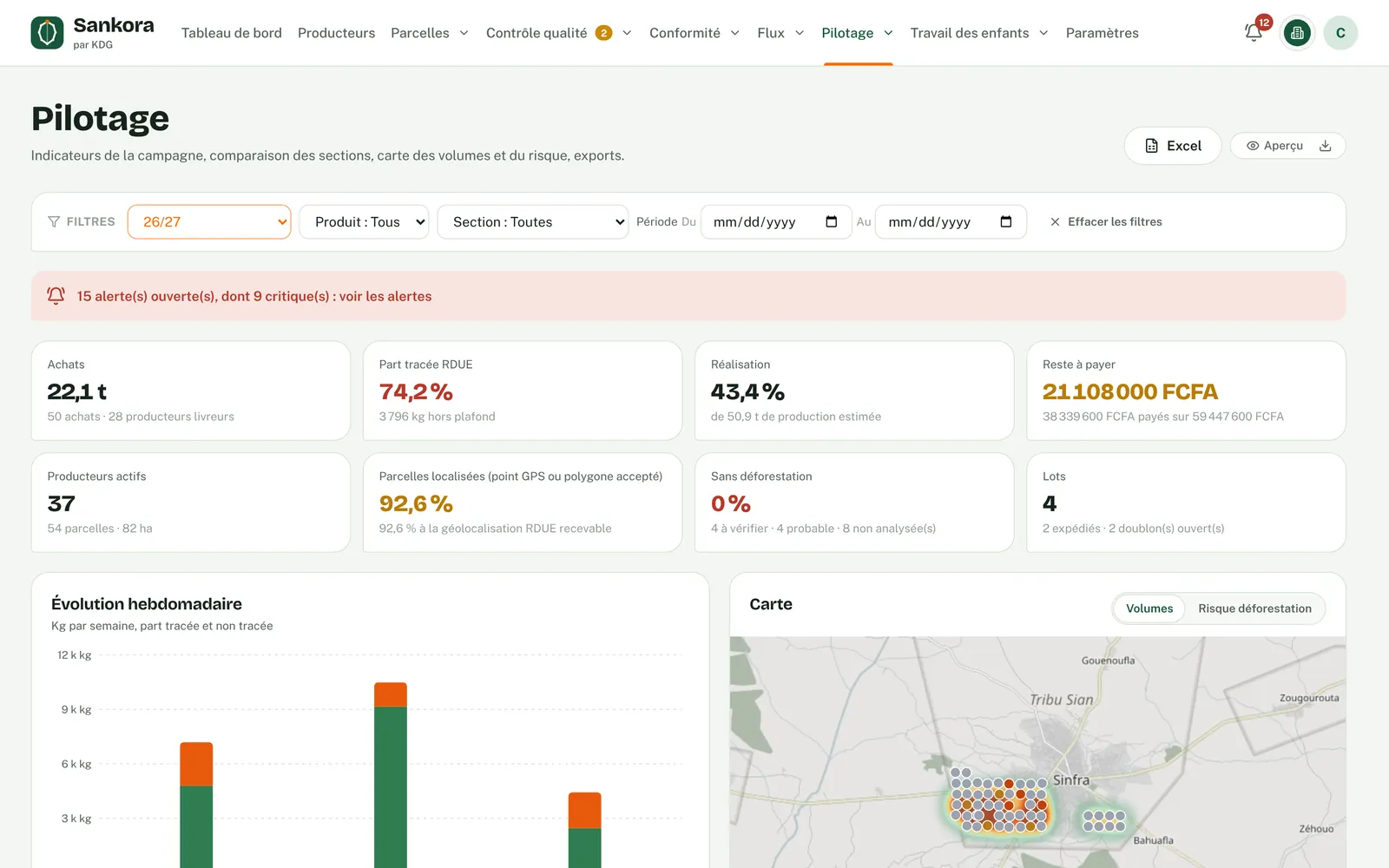
We design a simple tool for the cooperative to manage members, purchases, premiums and payments. Producers know what they delivered and what they received.
We design the questionnaires, train the enumerators, supervise data collection and deliver clean, analysed data ready to present.
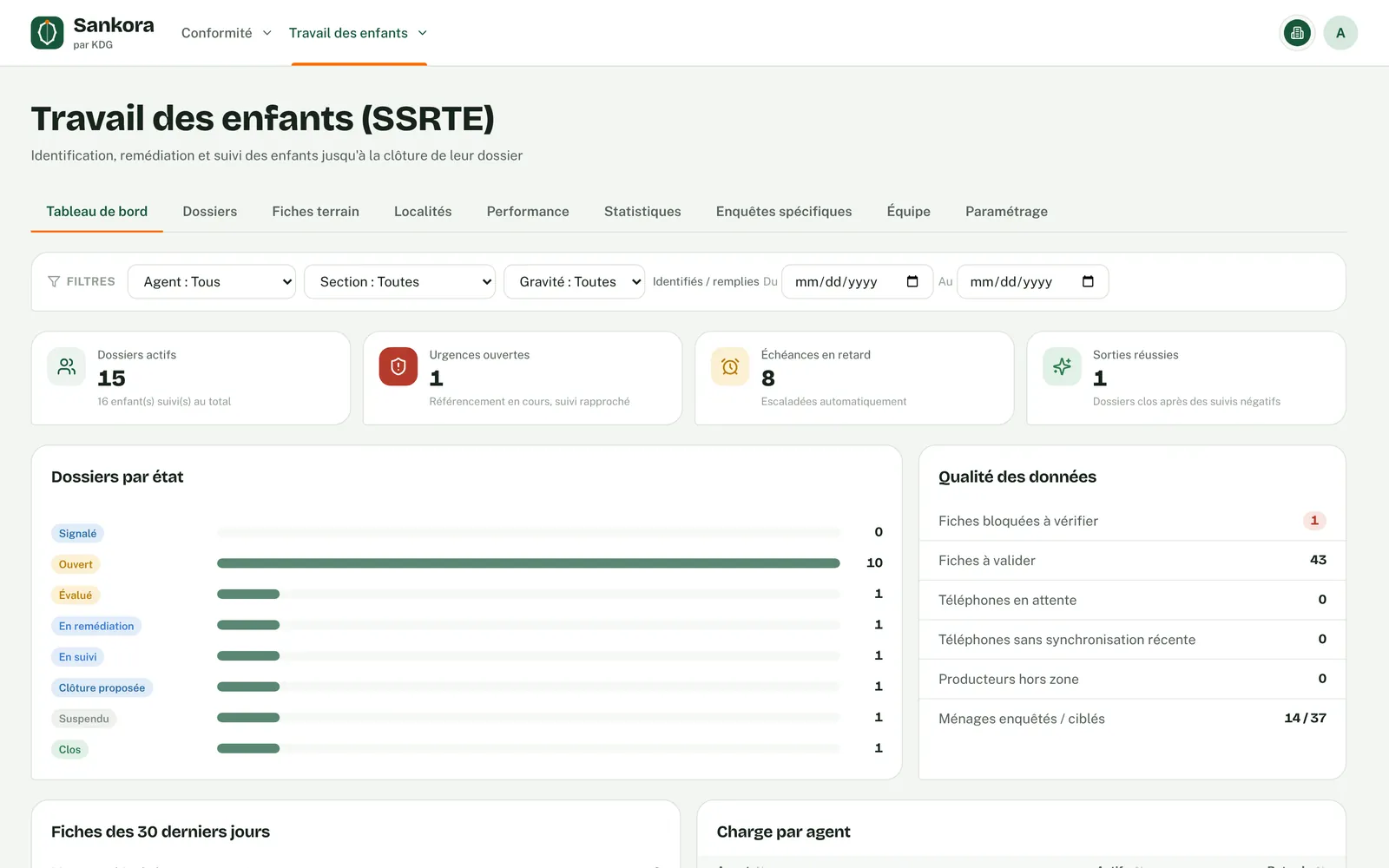
Digital tools for child labour monitoring and remediation systems (CLMRS), designed with your child protection teams.
We combine satellite imagery, machine learning models and season histories to anticipate rather than simply observe.
Cooperative, exporter, buyer or programme: choose your starting point.
Member registry, purchases, mobile money payments and training.
SeeFor exporters and buyers: EUDR, due diligence, forced labour and sustainability.
SeeFrom assessment to support, a rollout aligned with your seasons.
SeeSurveys, monitoring and evaluation, and dashboards for your donors.
SeeYour field agents collect data in the field, your teams monitor activity from the office, and your buyers receive the data they need.
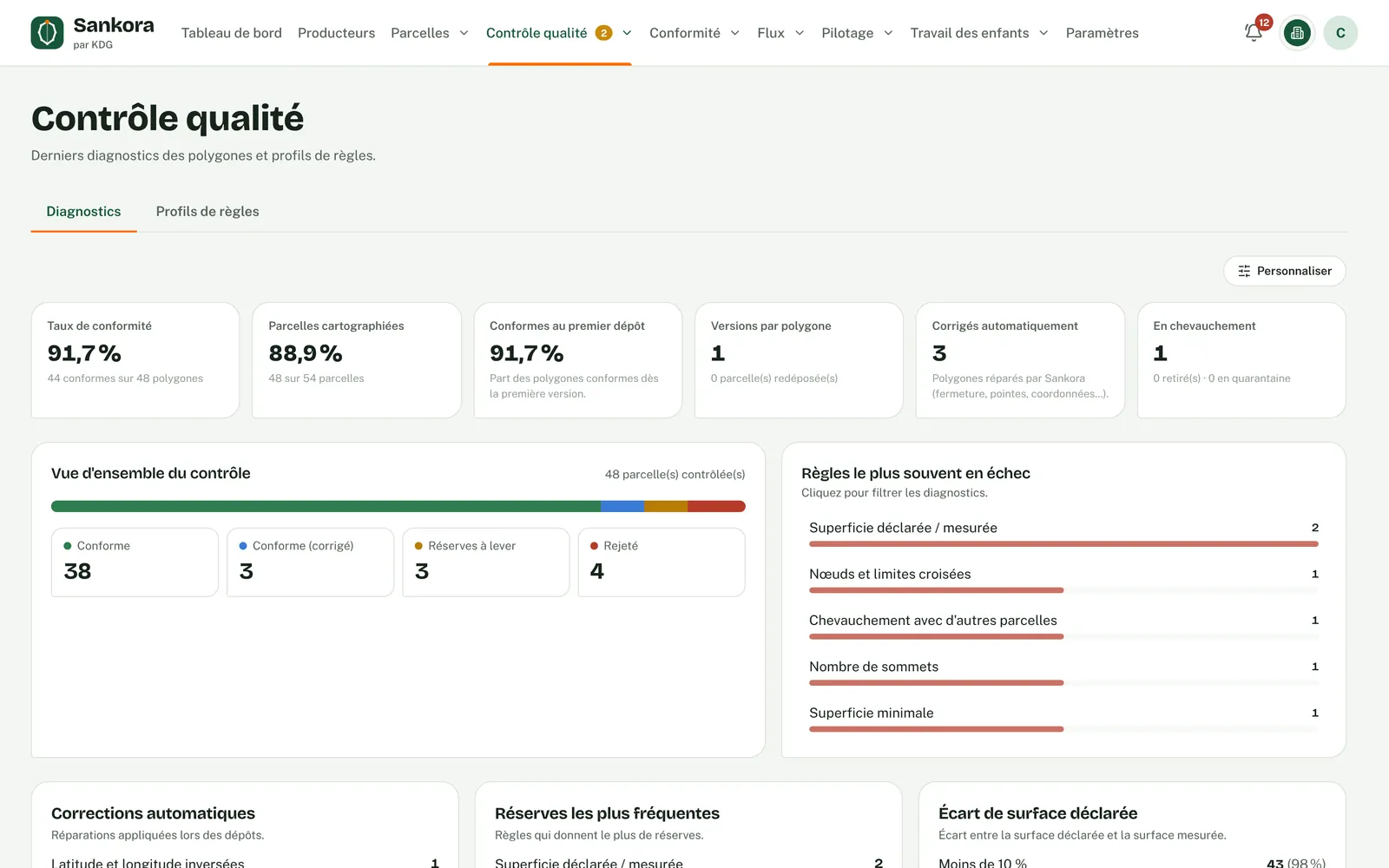
Example interface designed to illustrate our projects, using fictitious data.
The EU Deforestation Regulation (EUDR) requires cocoa, coffee, rubber, oil palm, soya, wood and cattle placed on the EU market, or exported from the EU, to be “deforestation-free”, produced in accordance with the relevant legislation of the country of production and covered by a due diligence statement.
Until the regulation applies to large and medium-sized operators and traders, on 30 December 2026. Micro and small operators: 30 June 2027 (30 December 2026 for those already covered by the EU Timber Regulation).
5 questions, 2 minutes. An indicative score and instant recommendations.
The interactive test could not load on this page. Its five questions cover the geolocation of your plots, the link between each lot and its producers, checking for no deforestation after 31 December 2020, the centralisation of your data, and your ability to provide a due diligence file to a buyer. Let’s review this together, based on your situation.
Review your EUDR readiness with usAre all your producers’ plots geolocated (a GPS point, or a polygon above 4 ha)?
Can you link each lot sold to the producers and plots it came from?
Have you checked these plots for deforestation after 31 December 2020?
Is your producer data digital, up to date and centralised in a single tool?
Could you provide a due diligence file to a buyer who asked for it tomorrow?
Each value chain has its own calendar, actors and market requirements. We design every tool around your reality.
Traceability, EUDR, certification, child protection.
Lot origin, quality, mapping.
Plantation monitoring and traceability to the processor.
Smallholder growers and traceability to the oil mill.
Purchases, producer contracts and origin data.
Purchases, nut quality and inventory management.
Producer registry, inputs and seasonal credit.
Producer groups, market access, project monitoring.
Free assessment: a 45-minute conversation, by video call or in Abidjan, to analyse your supply chain and identify priorities.