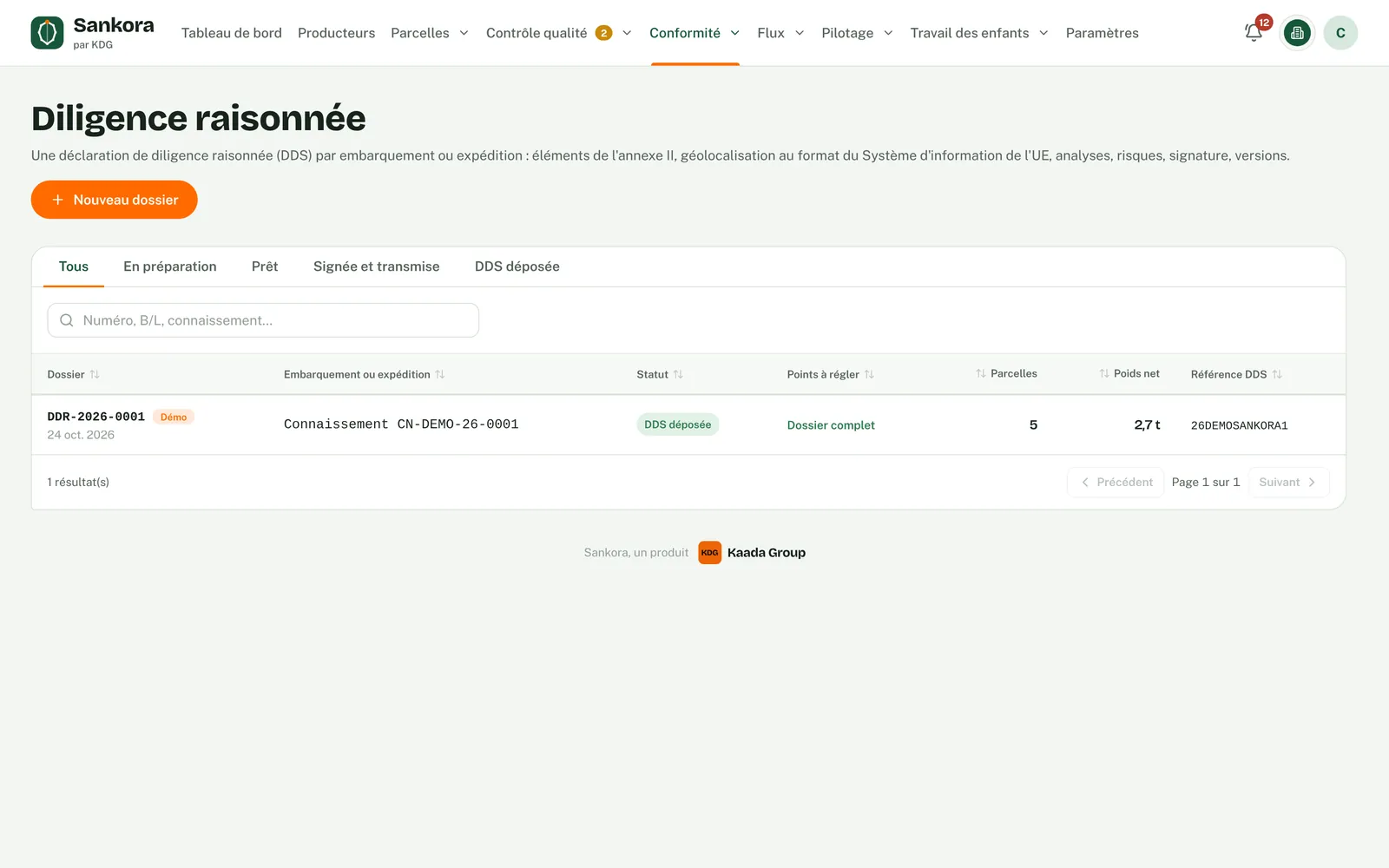
New Sankora, our agricultural traceability and EUDR compliance platform.Visit the Sankora website
Compliance

Meet your buyers’ requirements with verifiable data.

EUDR, due diligence, forced labour, sustainability reporting: companies that buy in Africa must know their supply chains. So they ask their suppliers for data. We design, build and deploy the tools that produce it, from the plot to the buyer.

What you are asked for

What your buyers must be able to demonstrate.

Requests vary by buyer and by market. They can cover four topics.

01

Origin

Who produced it, on which plot, in which lot.

02

Environment

No deforestation, and farming practices.

03

Human rights

Child labour, forced labour, working conditions and grievances.

04

Evidence

Documents, dates, authors and the history of corrections.

EU Deforestation Regulation (EUDR)

Cocoa, coffee, rubber, oil palm, soya, wood, cattle and certain derived products must be “deforestation-free”, with no deforestation after 31 December 2020, produced in accordance with the relevant legislation of the country of production and covered by a due diligence statement. The regulation applies from 30 December 2026 to large and medium-sized operators and from 30 June 2027 to micro and small operators (30 December 2026 for those already subject to the EU Timber Regulation).

What this requires

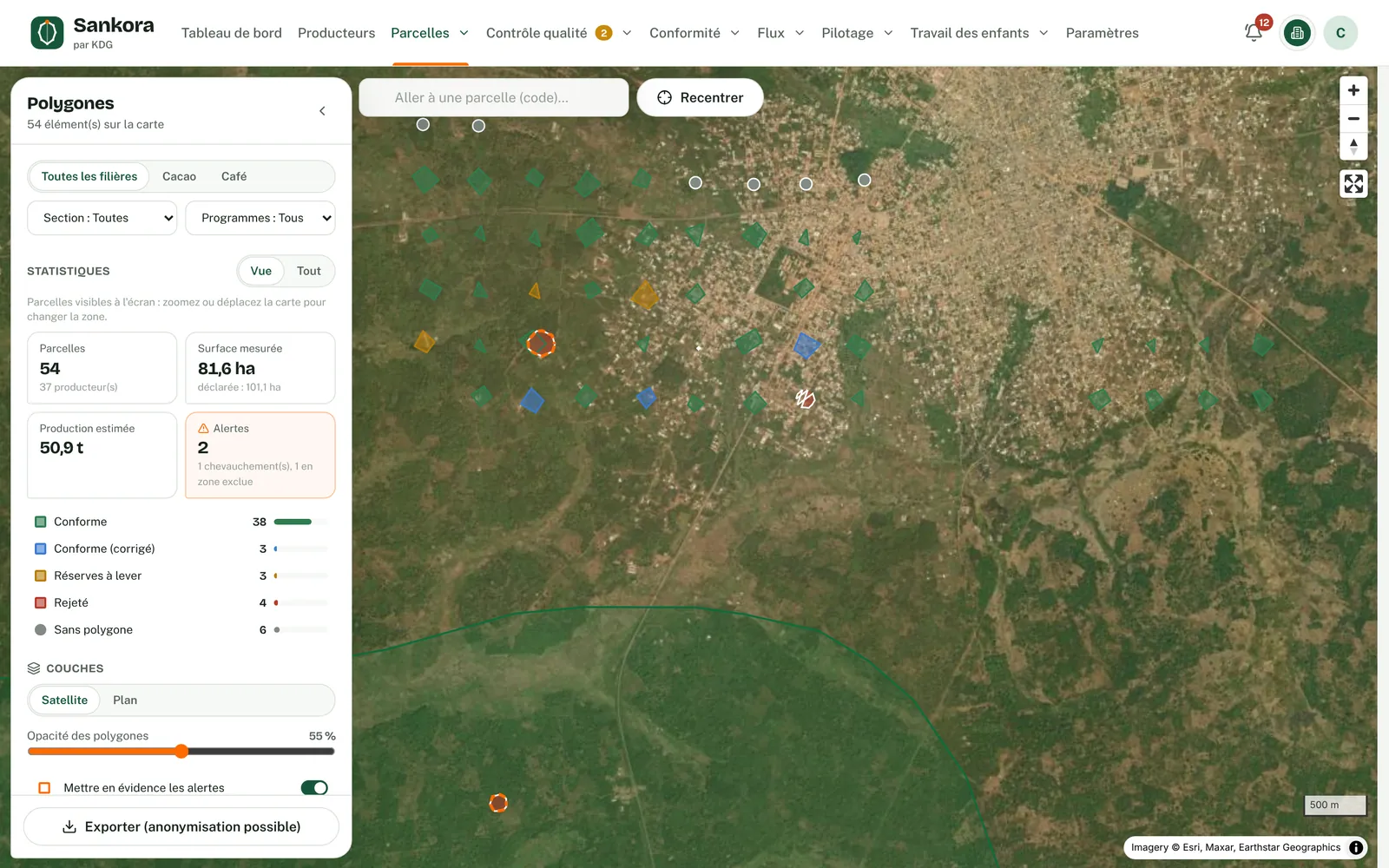
  • The geolocation of every production plot
  • The link between each lot and its plots, with no mixing with products of unknown origin
  • Information on the legality of production

What we design for you

  • Plot mapping, including the migration of existing maps
  • Lot-by-lot traceability, from farm gate to port
  • Data prepared for your buyers’ due diligence
EUDR timeline and test

Due diligence obligations of large companies (CSDDD)

This European directive, the EU Corporate Sustainability Due Diligence Directive, requires very large companies to identify and address adverse impacts on human rights and the environment in their operations and their chain of activities, and to have a complaints procedure in place. It was amended in 2026 and is scheduled to apply from 2029.

What this requires

  • Knowledge of the risks in the supply chain
  • Prevention and remediation measures that are monitored
  • An accessible grievance channel

What we design for you

  • Child Labour Monitoring and Remediation System (CLMRS): case identification and action follow-up
  • Grievance channel for producers and workers
  • Aggregated reports for your buyers

Ban on products made with forced labour

An EU regulation prohibits placing on the EU market, or exporting from it, any product made with forced labour, including when forced labour is used only at harvest. It applies from 14 December 2027.

What this requires

  • Information on working conditions at every stage
  • Documented due diligence measures, which the authorities may request during an investigation

What we design for you

  • Working conditions surveys, carried out in the field
  • Risk indicators and action follow-up

Sustainability reporting (CSRD)

Some large European companies publish information on their impacts, including in their value chain, under the EU Corporate Sustainability Reporting Directive. The scope of this directive was reduced in 2025 and 2026, and the rules aim to limit what is asked of small suppliers.

What this requires

  • Data on suppliers’ social and environmental practices
  • Field information rather than averages

What we design for you

  • Sustainability data collection at source
  • Documented data: the date, author and method of each record

Certification standards

Regardless of the law, many buyers rely on certification standards, each with its own requirements for traceability, farming practices, working conditions and audits.

What this requires

  • Up-to-date producer registries and maps
  • Evidence of training and premium payments

What we design for you

  • Data prepared for certification audits
  • Calculation and tracking of premium payments
Our expertise

The same data meets several sets of rules.

A reliable registry, purchases linked to producers and documented social actions serve the EUDR, your buyers’ due diligence and your certifications at the same time. We start from what you already have, then build what is missing.

Producer registry

One unique ID per producer, with no duplicates, linked to their plots, deliveries and payments.

Plot mapping

Plot surveying, migration and cleaning of existing maps, and cross-checking them against forest cover maps.

Lot traceability

Each lot linked to its producers, with volumes reconciled at every stage.

Social and sustainability data

Child labour monitoring, grievances, training and practices, collected and protected.

A file for your buyers

Exports in open formats and reports at the level of detail you choose.

See our producers and cooperatives expertise

Frequently asked questions

Your questions about compliance.

My buyer is asking me for data. Where do I start?
With a list of what they are asking for and what you already have: producer registry, maps, purchase records. The first gap to close is often the link between lots and producers.
Who submits the EUDR due diligence statement?
The operator that places the product on the European Union market or exports it, most often the importer. The exporter and the cooperative provide the operator with the data and evidence it needs. That is the part we help you produce.
Can you guarantee that my lots will be accepted?
No. The decision lies with your buyer and the competent authorities. We help you have complete, consistent and verifiable data.
We already have plot maps. Do we have to start again?
Not necessarily. We take over the existing files, check their quality, correct what can be corrected and identify the plots that need to be surveyed again.
Who owns the data?
You do. It can be exported in open formats, such as GeoJSON and CSV, so that you can share it or switch tools.

Are your buyers asking you for data?

Let’s review what you already have and what is missing. Free assessment: a 45-minute conversation, by video call or in Abidjan.