Traceable
Every farmer, plot and bag is linked, from weighing to container.
Sankora helps cooperatives, exporters and buyers know every farmer, every plot and every bag, prove it, and measure their impact in the field.
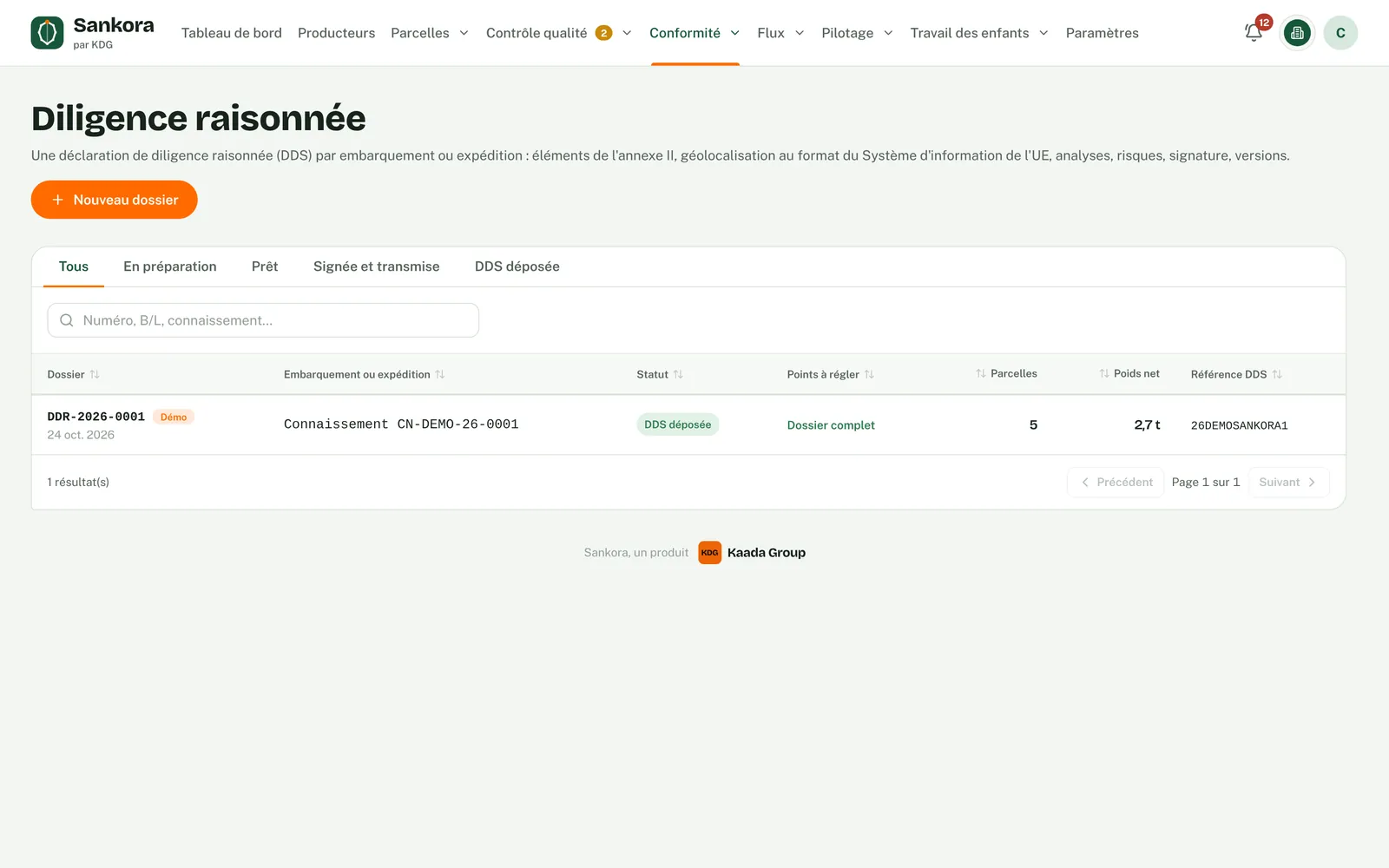
We give supply chain actors the means to prove the good they do, from the farmer's plot to the European market.
Every farmer, plot and bag is linked, from weighing to container.
Verified evidence for the EU deforestation regulation and for your buyers.
Protected children, trained farmers and renewed orchards, with measured results.
From the farmer census to the file submitted to the European Union, every piece of data is entered only once.
Farmer records, import of Excel lists and plot surveys (KML, GeoJSON, GPX), automatic polygon checks and fixes.
Learn moreWeighings linked to plots, cash or mobile money payments, lots, shipments and containers.
Learn moreSatellite deforestation checks, protected areas, risk assessment by lot, supplier or contract.
Learn moreAnnex II information gathered, checked by a second person, statement ready for TRACES.
Learn moreChild protection, training and orchard renewal: your programmes tracked farmer by farmer, with results your partners can verify.
Identify children exposed to hazardous work, support them and follow each one until they are out, even offline.
Discover Data4ChildTraining sessions and attendance on a phone, plot visits, adoption rates by practice and community.
Learn morePlanting and pruning: seedling distribution, geolocated planting, survival, pruning and rehabilitation.
Learn more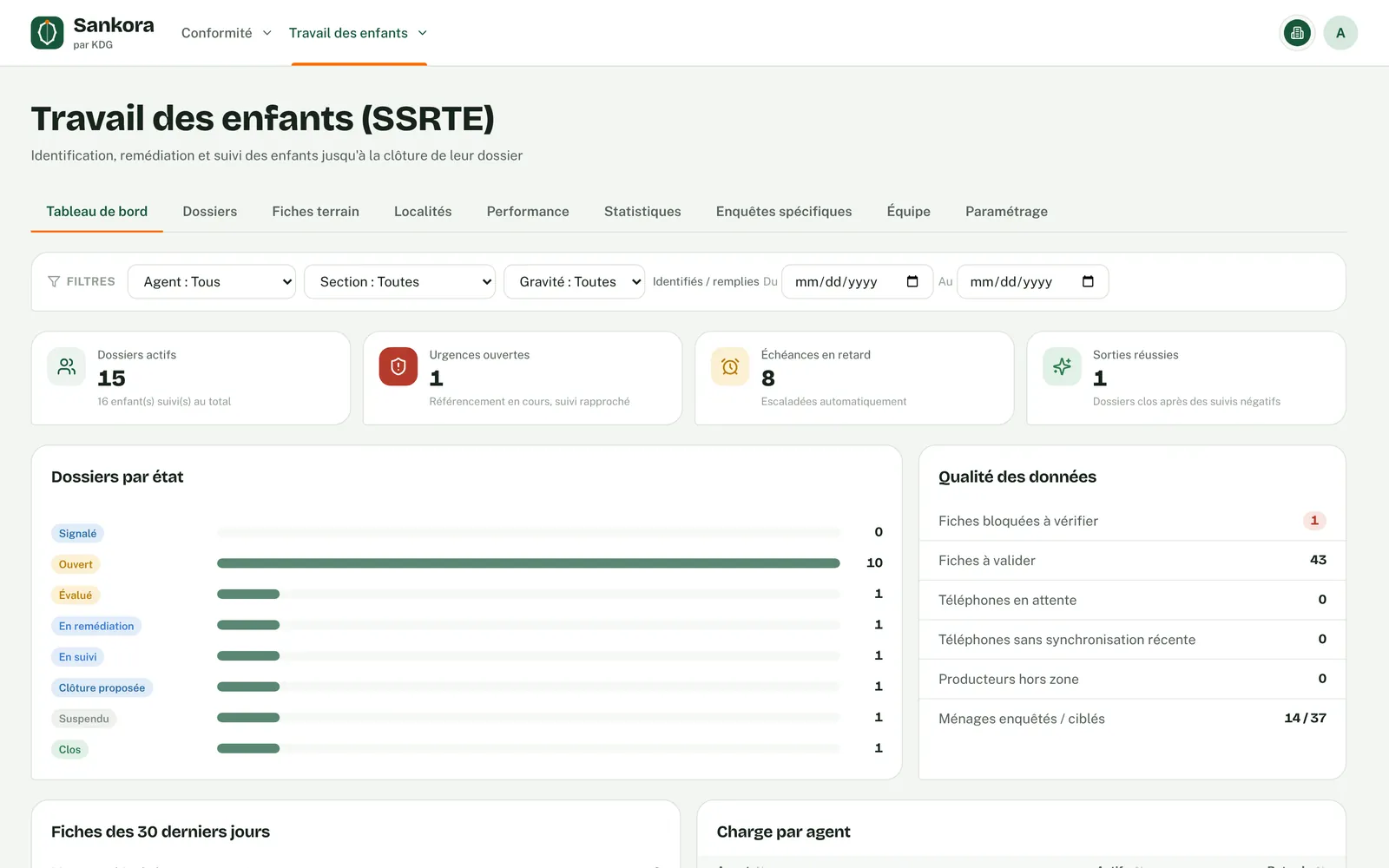
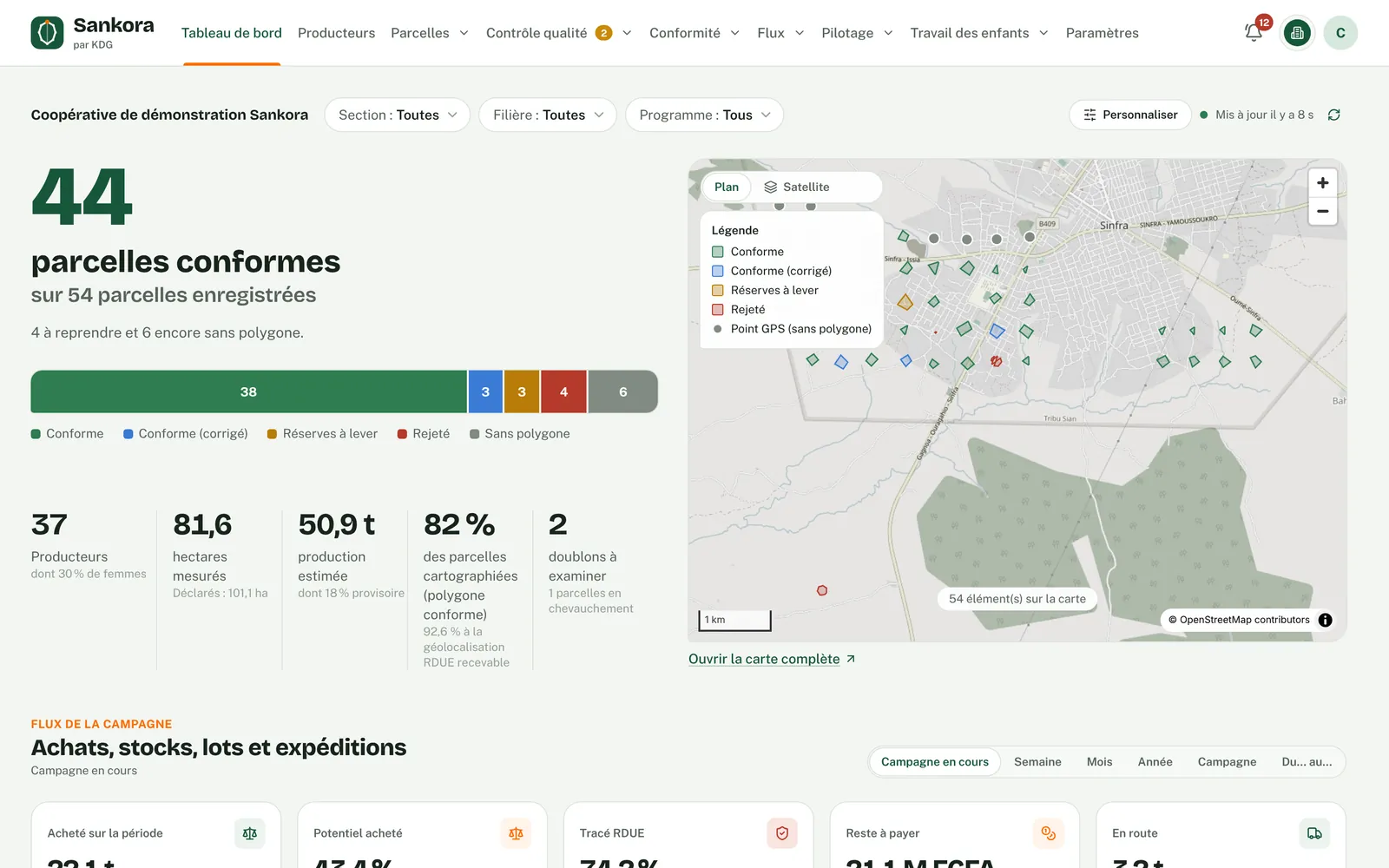
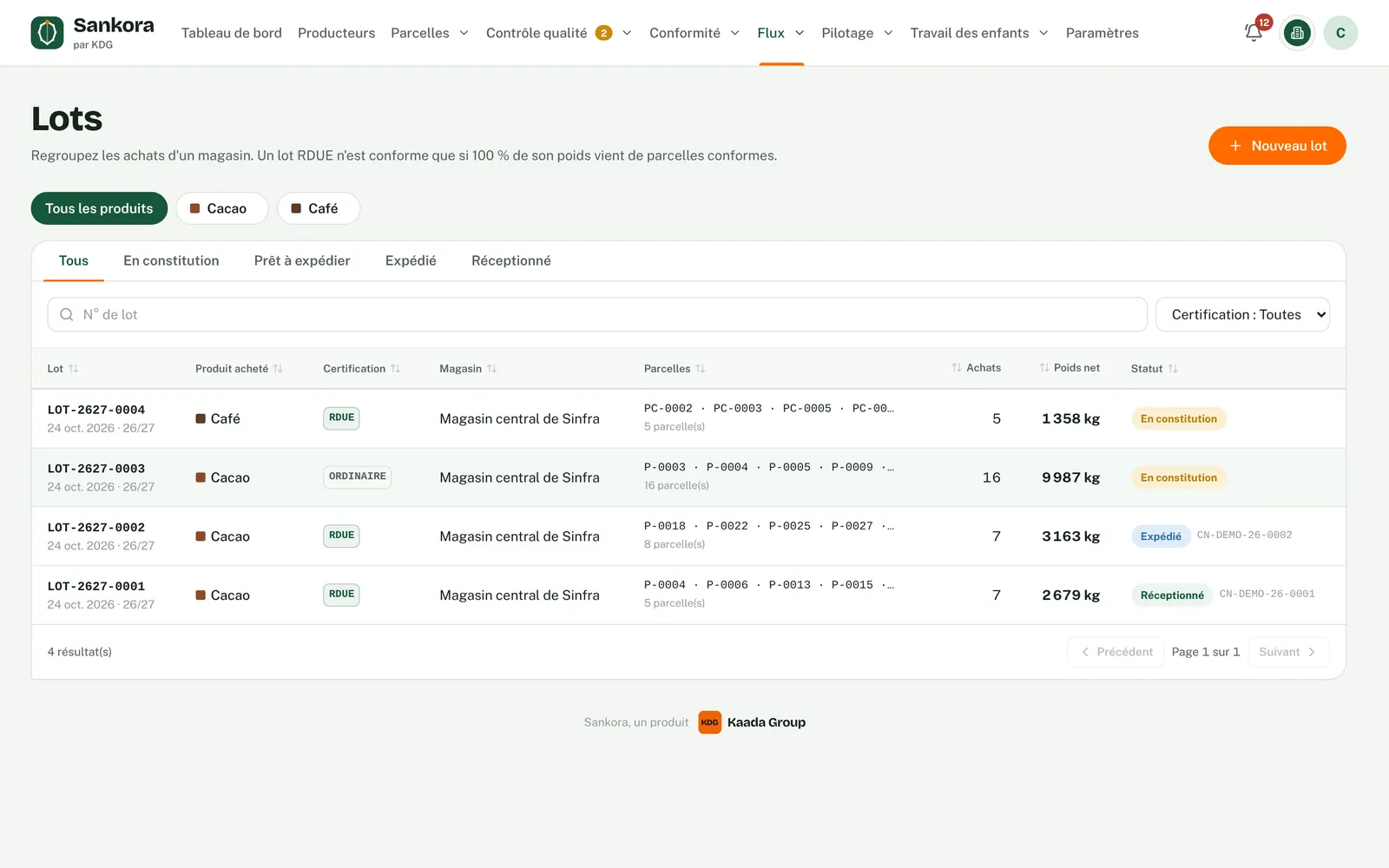
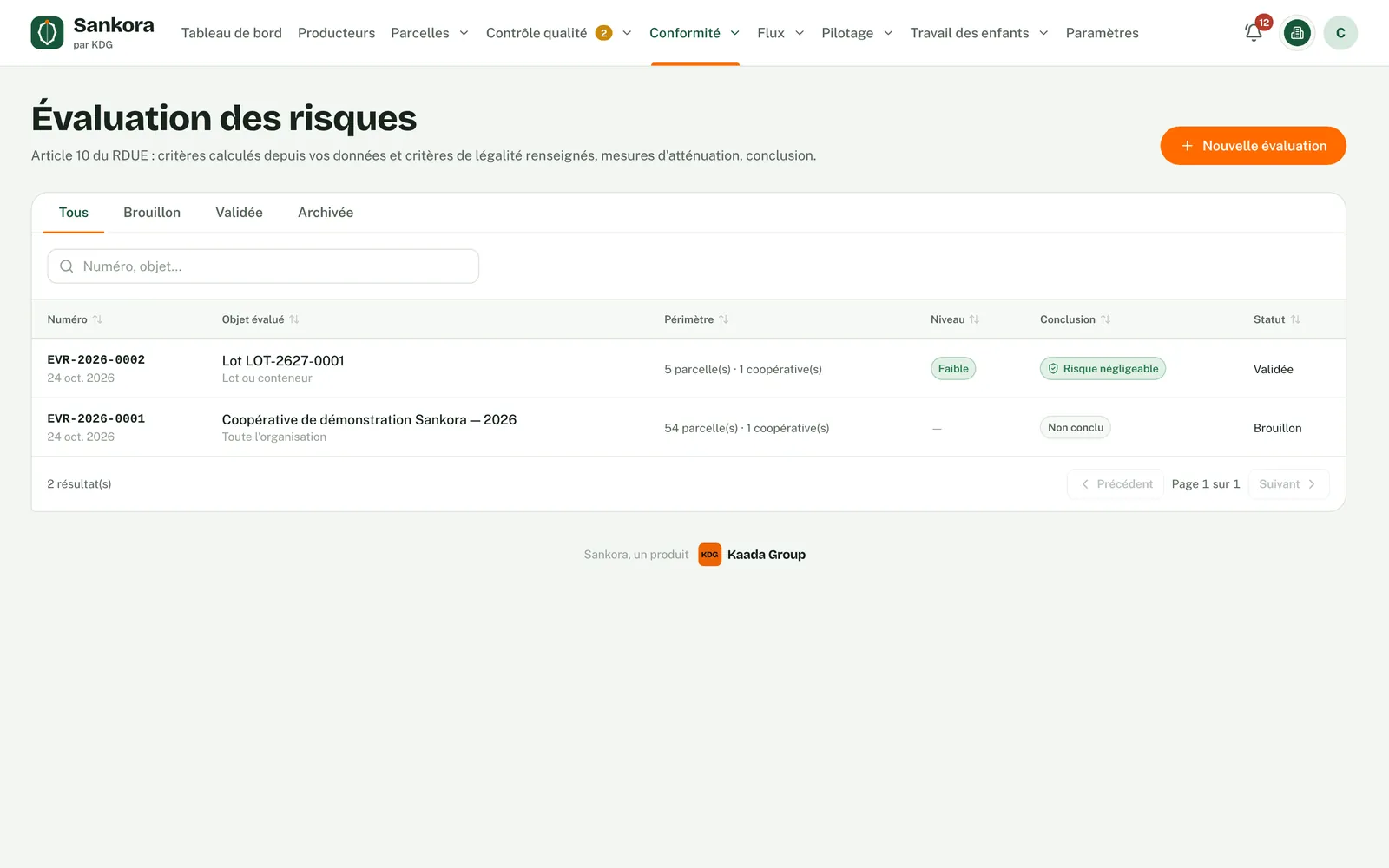
This is Sankora for real: every screen is a capture of the platform, with demo data.
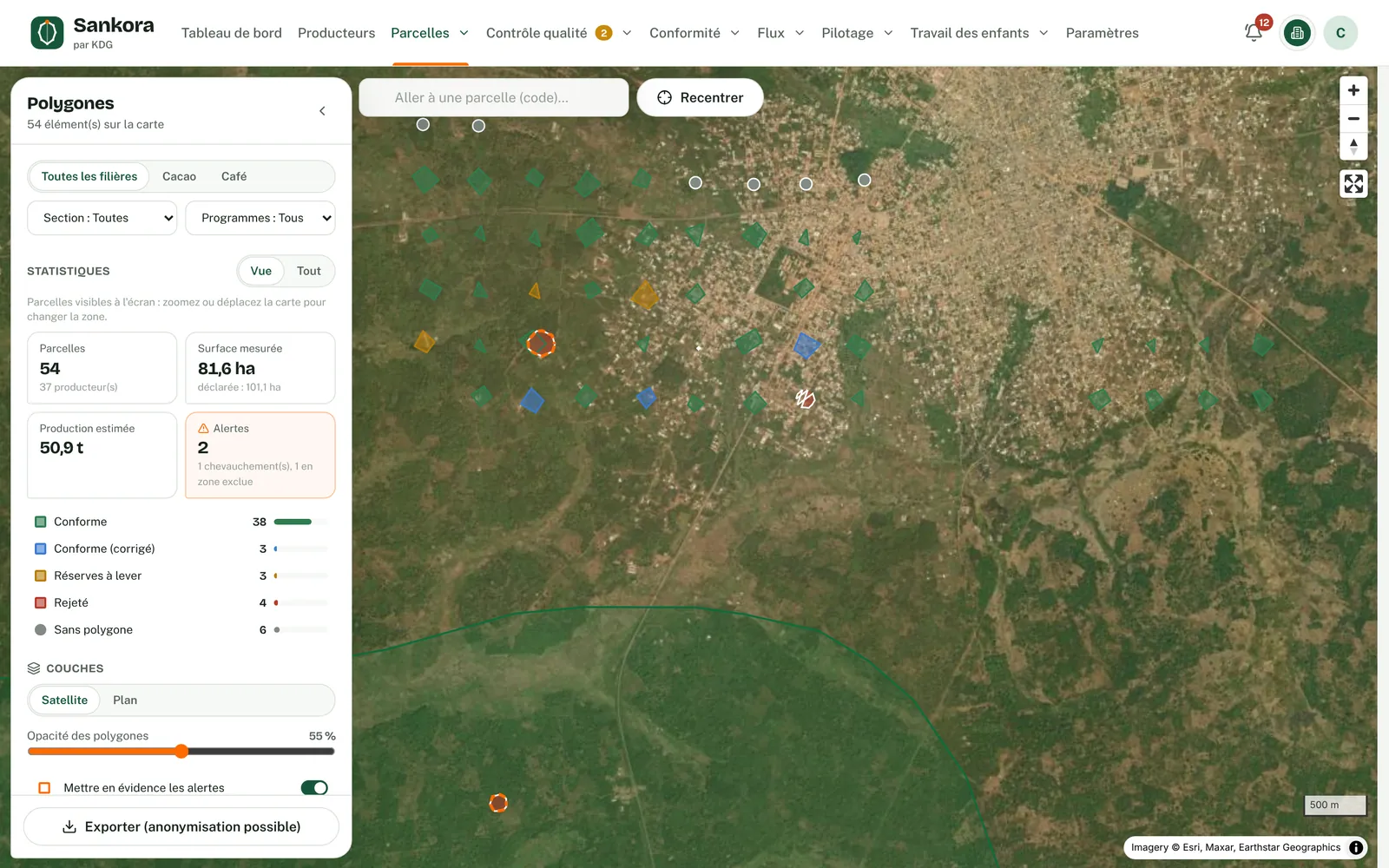
Your farmer lists and plot surveys (Excel, KML, GeoJSON, GPX) go into a single register, each plot linked to its farmer.
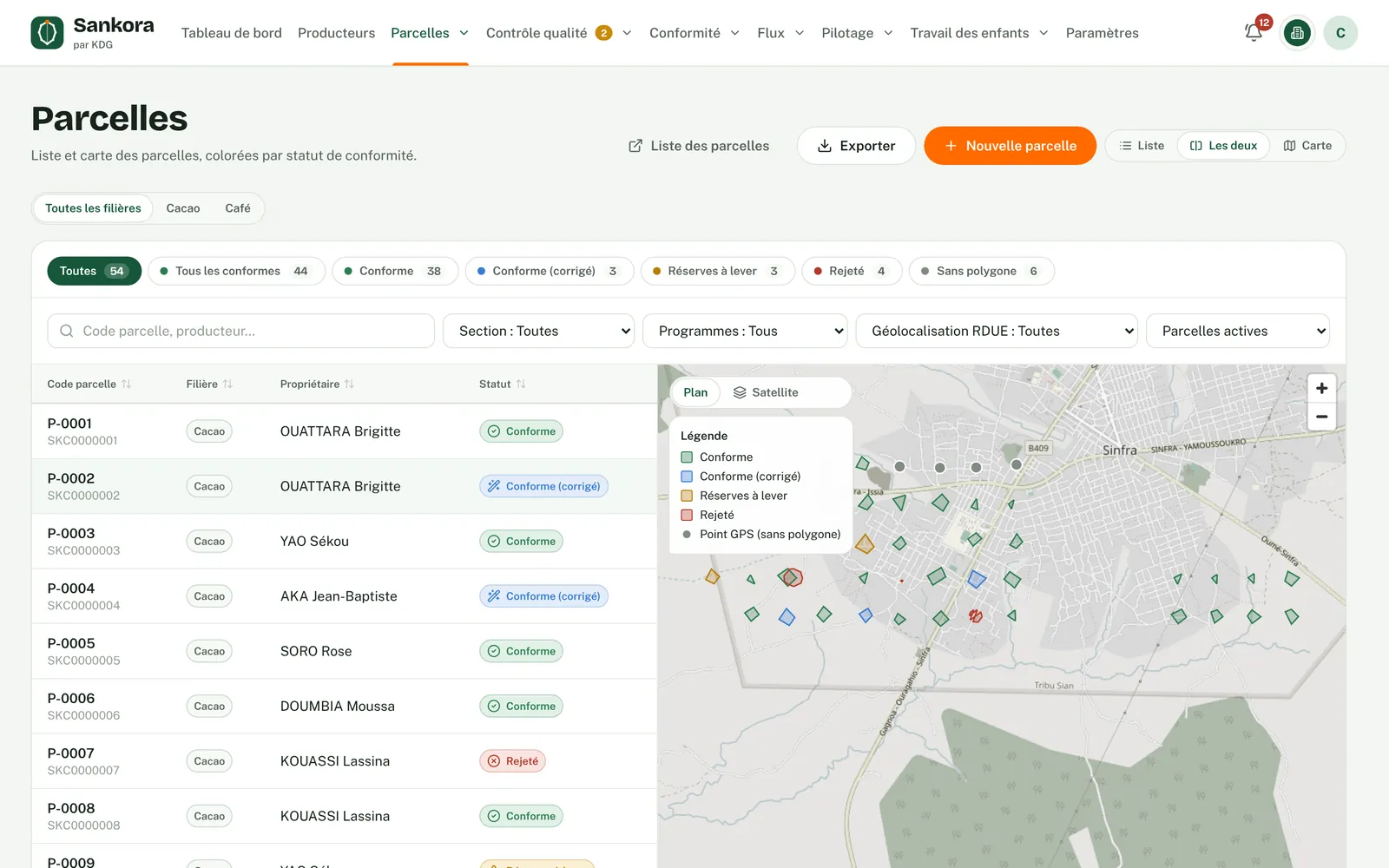
Overlaps, self-intersections, area gaps: every polygon goes through control rules, and simple errors are fixed without re-entry.
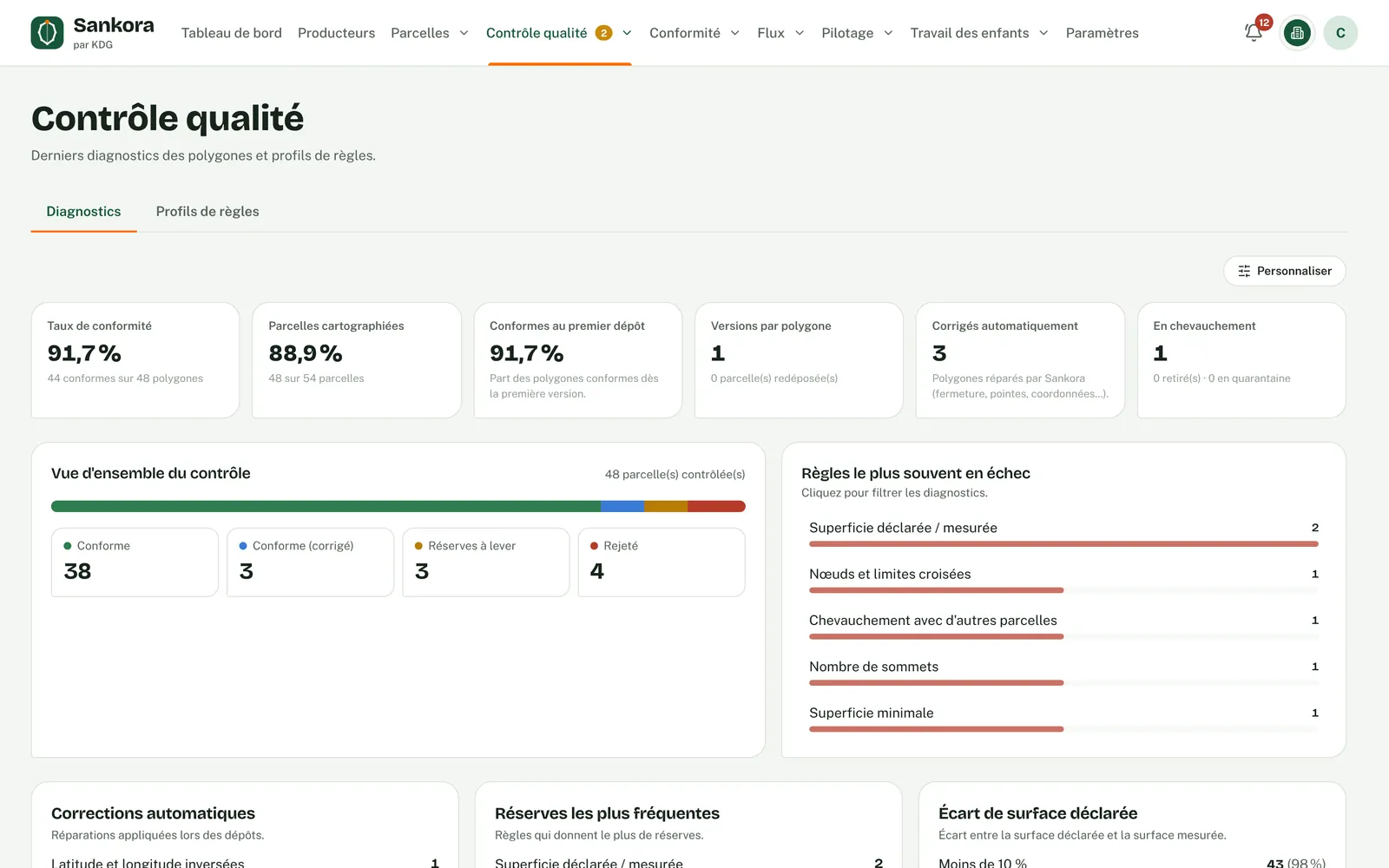
Each plot is compared with forest cover on 31 December 2020 and with satellite alerts, right inside the application.
Lots traced back to the plot, risk assessment and a complete due diligence statement, ready to submit in TRACES.
Our first commodity, in Côte d'Ivoire: EUDR and child labour.
DiscoverRobusta and arabica, with the same EUDR requirements as cocoa.
DiscoverRegistry, purchasing and traceability for cashew nuts.
DiscoverNatural rubber falls within the scope of the EU regulation.
DiscoverGeolocated smallholder plantations and compliance with the EU regulation.
DiscoverRegistry, purchasing and traceability; soy also falls within the EUDR's scope.
DiscoverFarmers, plots and lots traced to meet buyers' requirements.
DiscoverShea kernel collection from women producers' groups, traceable to export.
DiscoverMore commodities will follow, based on our clients' needs.
Sankora is designed and developed by Kaada Group in Abidjan, with teams who know cooperatives, marketing seasons and field constraints. One farmer register serves traceability, EU regulation compliance and sustainability programmes.
Traceability, EUDR, child protection and programmes share the same farmers and plots: nothing is entered twice.
Sankora never makes up coordinates. A lot is compliant only if all its weight comes from compliant plots.
Whoever drafts an assessment or prepares a statement does not approve it: a second person always checks.
Data4Child forms on Android without a network, cash or mobile money payments never blocked, screens designed for field officers.
Each organisation sees only its own data and chooses what it shares. Children's data stays restricted.
An Ivorian software company, working in French and English, that trains your teams in the office and in the villages.
See the platform in detailHow Sankora worksKaada Group, the publisher
Cocoa, coffee, rubber, oil palm, soy and their derived products sold in the European Union will have to come from plots that were not deforested, are geolocated and are covered by a due diligence statement. Here are the dates that matter, and what they change for you.
—days until the rules apply to large and medium companies
A product is compliant only if it comes from a plot that was neither deforested nor degraded after 31 December 2020. Satellite analysis compares today's forest cover with that date.
For you : Every one of your farmers' plots must be geolocated so it can be checked against this date.
The text covers seven commodities: cattle, cocoa, coffee, oil palm, rubber, soy and wood, and their derived products. It requires due diligence: collecting information, including geolocation, then assessing and mitigating risk.
For you : European buyers started asking their suppliers for plot coordinates.
The timeline moves back by one year. Only the operator who first places the product on the market submits the statement; downstream operators and traders keep the reference numbers. Micro and small primary operators can use a simplified declaration.
For you : Your buyer or exporter remains responsible for the statement, but it depends on your field data.
The European Commission published its review, updated its guidance and FAQ, and ruled out any further delay. The EU Information System, where statements are submitted, reopened at the end of June 2026.
For you : There is no reason left to wait: checks start on the planned dates.
Medium and large operators and traders must submit a due diligence statement for each placing on the market. Côte d'Ivoire is classified as standard risk: full due diligence applies and authorities check a share of operators every year.
For you : Your lots must be linked to compliant plots before shipment, not after.
The smallest operators, outside the timber sector, apply the regulation in turn, with a simplified declaration for primary operators.
For you : Small cooperatives and small exporters get six more months, not an exemption.
A delegated act adopted in July 2026 adds products such as soluble coffee and certain palm oil derivatives, and removes others from the scope, such as leather.
For you : If you supply coffee or palm oil processors, they will ask you for the same proof.
Sources: Regulation (EU) 2023/1115 as amended by Regulation (EU) 2025/2650; Commission review of 4 May 2026; July 2026 delegated act on product scope; Implementing Regulation (EU) 2025/1093 on country classification. Checked on 25 October 2026.
Answers to the questions cooperatives, exporters, buyers and programmes ask us most often.
Regulation (EU) 2023/1115 bans placing on the EU market, or exporting from it, products linked to deforestation. Companies must prove, through due diligence, that what they sell comes from plots that were not deforested and were produced legally.
Cattle, cocoa, coffee, oil palm, rubber, soy and wood, and the derived products listed in Annex I: chocolate, cocoa butter, palm oil, tyres, furniture, etc. Soluble coffee and certain palm oil derivatives are added on 30 December 2027.
On 30 December 2026 for large and medium companies, and on 30 June 2027 for micro and small companies outside the timber sector. In May 2026 the Commission confirmed there would be no further delay.
It is the cut-off date: the plot must not have been deforested or degraded after that day. A plot planted on forest cleared in 2021 cannot supply the European market.
The operator who first places the product on the EU market, or exports it. Downstream operators and traders keep the references of their suppliers and customers for five years.
A GPS point is enough for a plot of 4 hectares or less. Above that, the full plot boundary is mandatory. Sankora shows you which plots still need a polygon.
It is classified as standard risk by Implementing Regulation (EU) 2025/1093. Full due diligence therefore applies: information, risk assessment and, where needed, mitigation measures.
Member States set the penalties: fines of up to at least 4% of annual turnover in the EU, confiscation of products and revenue, temporary exclusion from public procurement. For a supplier, the most immediate risk is losing its buyers.
No, these value chains are outside the EUDR. Their buyers increasingly ask for the same traceability anyway, under their due diligence duties or certifications: Sankora works the same way for them.
Each polygon is compared with 2020 forest cover and deforestation alerts on satellite imagery, and with protected areas. Doubtful cases are flagged for review; an assessment is approved only by a second person.
The plot is quarantined and sent back for correction. Sankora never makes up coordinates: everything that goes into a file was recorded in the field.
A lot is compliant only if all its weight comes from compliant plots. Every weighing is linked to a plot, every bag goes back to its farmer, and a mixed lot is flagged before shipment.
No. Sankora prepares a complete Annex II file, with geolocation in the EU system format, checked by a second person. Your company submits it and remains responsible for it.
No. An exporter can receive its partner cooperatives' data in Sankora, and each cooperative decides what it shares.
Yes for Data4Child data collection: field officers fill in forms on Android without a connection, and they are sent automatically once the network is back. Plot surveys made with your GPS tools are then imported into Sankora, which checks them.
Yes. Your farmer and plot lists can be imported from Excel, and your boundaries from KML, GeoJSON or GPX files. Every imported polygon goes through the same control rules, and simple errors are fixed automatically.
In cash, by mobile money, bank transfer or cheque. The app never blocks a payment, and payment proofs are optional.
No. Data4Child is a Sankora module for child labour monitoring and remediation (CLMRS). You switch it on if you need it, on the same farmer register.
Each organisation sees only its own data and decides what it shares. Children's personal data is restricted to the monitoring manager and management; buyers only receive anonymised statistics.
Yes. The plot register can be exported to Excel and polygons to GeoJSON, with an option to anonymise names.
French and English, for the web application and the documents it produces.
By subscription, based on the services you choose, on quotation. Everything is set out in a contract; any change of services or price goes through a signed amendment.
Once the contract is signed, we open your workspace with the chosen services, bring in your existing data and train your teams, in the office and in the field.
Yes. We show you the application on our demo, with examples close to your value chain. Request it with the contact form.
Keep your member list, trace your purchases and prove the origin of what you sell.
Secure your sourcing and file robust EUDR statements.
Receive verifiable evidence on the origin and social impact of your purchases.
Track your projects farmer by farmer and measure their results.
Tell us where you stand: registry, EUDR, child protection or a sustainability programme. We will show you Sankora with examples close to your business.
Abidjan, Côte d'Ivoire