The essentials in one minute
Regulation (EU) 2023/1115, known as the EU Deforestation Regulation (EUDR), prohibits placing on the EU market, or exporting from it, products that are not all three of the following: “deforestation-free” after 31 December 2020, produced in accordance with the relevant legislation of the country of production, and covered by a due diligence statement. It covers seven commodities: cocoa, coffee, rubber, oil palm, soya, wood and cattle, as well as many derived products such as chocolate, cocoa butter and tyres.
The obligation falls on the operator that places the product on the EU market or exports it, which in practice is most often the European importer. But to meet it, operators need data from their suppliers: exporters, cooperatives and, at the end of the chain, producers. A cooperative that cannot provide this data risks losing its buyers.
Key dates
After two postponements, the main obligations apply:
- From 30 December 2026 for large and medium-sized operators and traders.
- From 30 June 2027 for micro and small operators (30 December 2026 for those already covered by the EU Timber Regulation).
- From 30 December 2027 for products added to the list in 2026, including instant coffee.
Buyers may ask for this data before the official date, so it is better to prepare now.
What you must be able to prove
- The geolocation of each plot: a GPS point is enough for plots of 4 hectares or less; above that, the full polygon is required. For cattle, geolocation applies to the establishments where the cattle were kept.
- No deforestation on these plots after 31 December 2020.
- The legality of production under the laws of the country of production, including: land use rights, environmental protection, forest-related rules, labour rights and human rights, third parties’ rights, tax, anti-corruption, trade and customs.
- The link between each lot and the plots it came from, with no mixing with unverified products.
- A due diligence statement, submitted by the operator to the EU information system before the product is placed on the market or exported.
Five steps to be ready
- Take stock. How many producers, how many plots already mapped, what data exists and in what state?
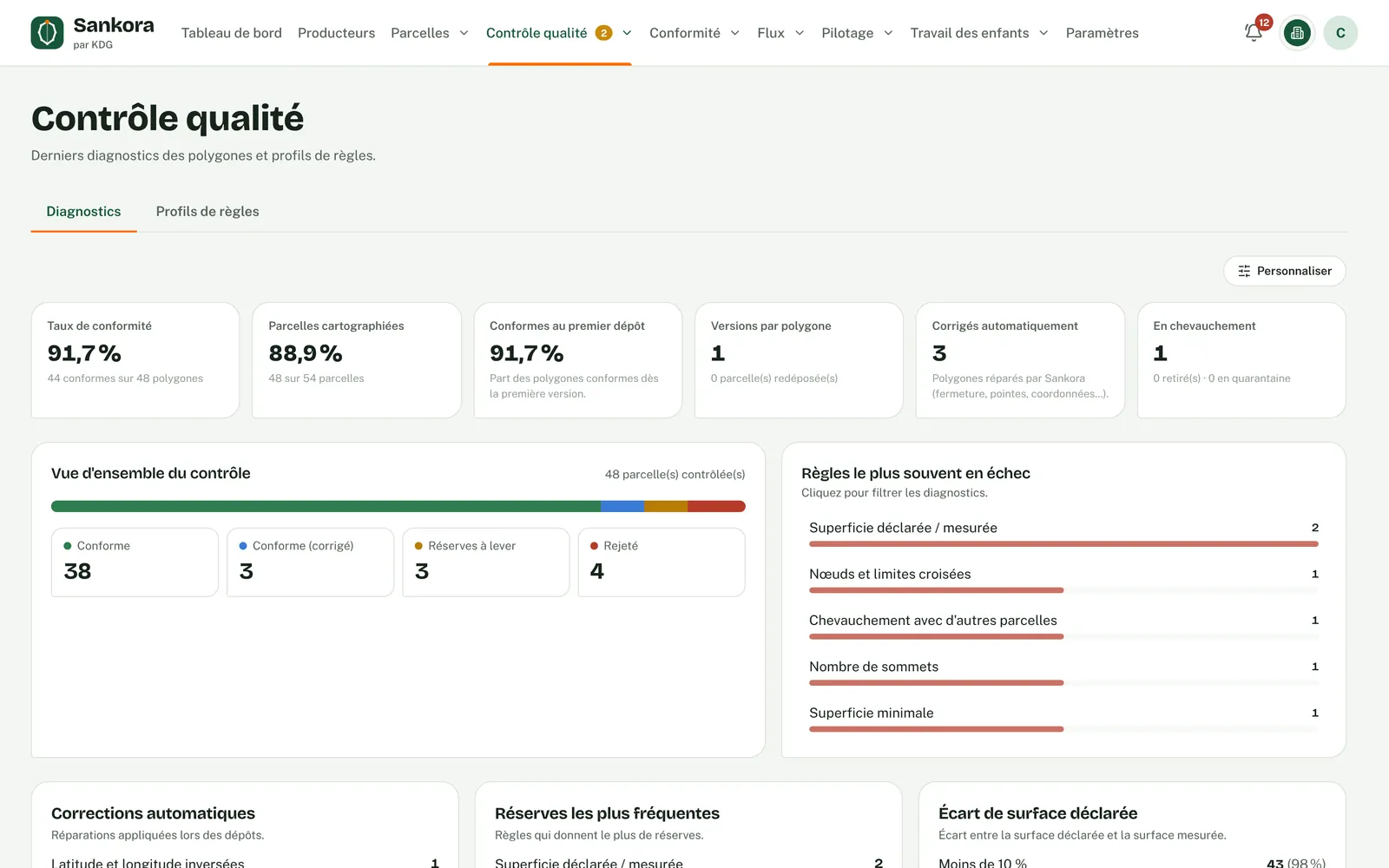
- Map. Record GPS points and polygons with an offline app and an accuracy check, then check for overlaps.
- Cross-check with satellite imagery. Compare each plot with forest cover maps to identify areas at risk.
- Trace the flows. Record every purchase, link each bag to its producer and follow lots all the way to the port.
- Document. Gather the evidence in a file your buyers can use directly.
The most common mistakes
- Polygons recorded too quickly, with insufficient GPS accuracy.
- Producer lists duplicated across several cooperatives.
- Data on paper or in Excel files that cannot be consolidated.
- Traceability that stops at the cooperative and does not follow the lots.
How Kaada Group supports you
We design, develop and roll out what compliance requires: plot mapping with field teams, a data collection app that works offline, a traceability and analysis tool suited to your organisation, and satellite image analysis to support verification. You can start with the EUDR readiness test on our agritech page, or read about buyer requirements.
Up to date as of 11 October 2026. This guide is general information, not legal advice; refer to Regulation (EU) 2023/1115, as amended, on EUR-Lex, and to the European Commission’s EUDR page. These texts may change.
Free assessment: a 45-minute conversation with a Kaada Group expert, by video call or in Abidjan.