Why now
Smartphones are spreading in rural areas, satellite imagery has become accessible and markets are demanding ever more transparency. Together, these three changes make possible what was not possible ten years ago: knowing every plot, every producer and every lot precisely.
1. Offline mobile apps
They replace paper forms. The field agent enters data on the farm, even without a network; everything syncs on return. The result: fewer errors, less re-entry, and data available as soon as it syncs, faster than with paper forms.
2. GPS and geographic information systems
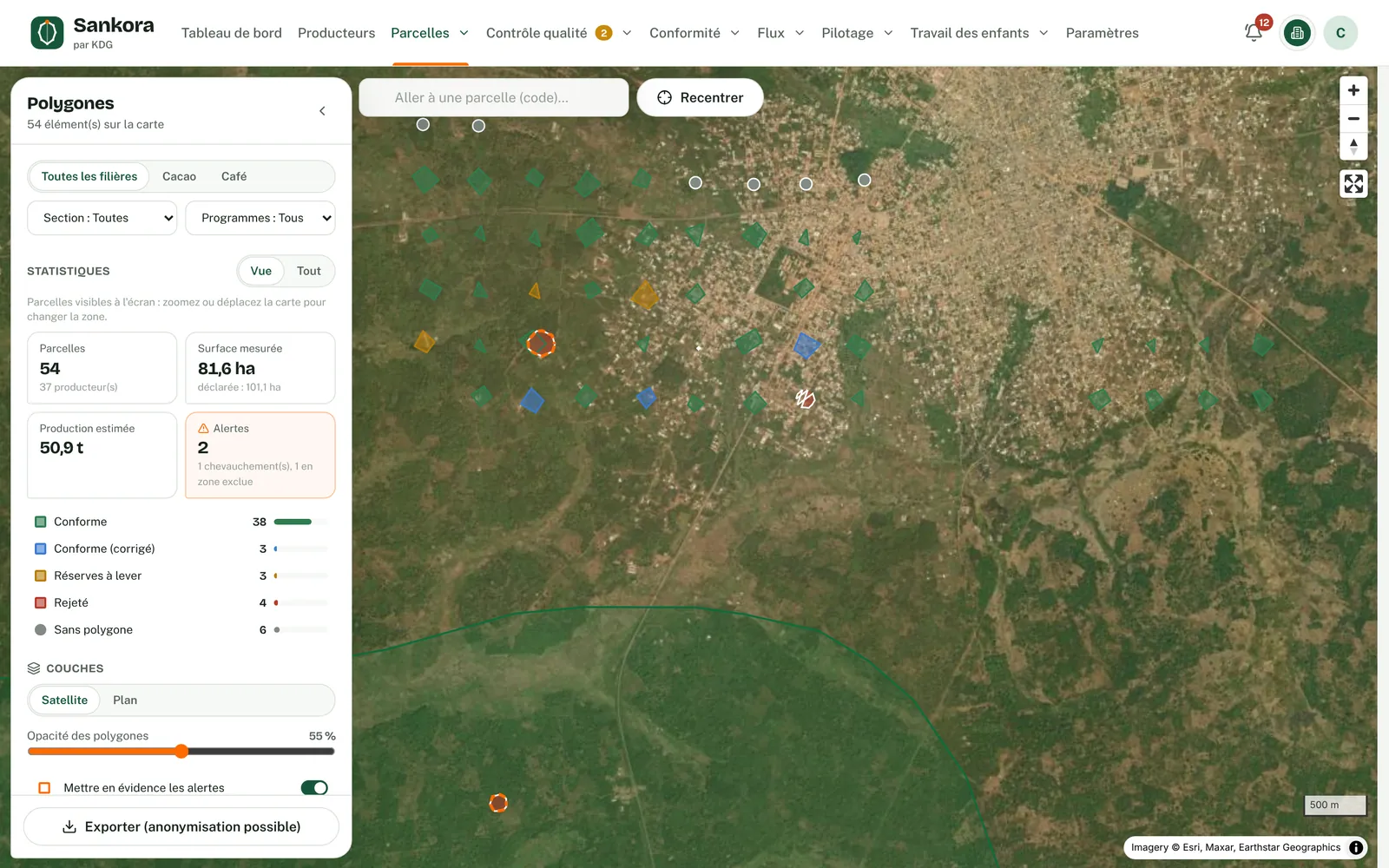
Each plot becomes a measured polygon linked to its producer. Actual areas make it possible to estimate expected volumes and to spot inconsistencies between declared production and cultivated area.
3. Satellite imagery
It makes it possible to monitor forest cover, crop condition and land-use change over large areas without travelling. It is one of the main tools for checking that there has been no deforestation, as the EU Deforestation Regulation (EUDR) requires, in support of due diligence.
4. Artificial intelligence
A computer vision model can help spot disease symptoms from a simple photo. Other models estimate yields, detect anomalies in data or direct field agents’ visits to the producers who need them most.
5. Sensors and connected devices
Weather stations, soil moisture probes, sensors in storage warehouses: they continuously measure what the eye cannot see and trigger alerts, for example before excess humidity damages a stock of beans.
6. Drones
They quickly map large farms with accuracy that can reach a few centimetres, thanks to precision positioning (RTK) or ground control points, and produce highly detailed images for monitoring plantations or reforestation projects.
7. Mobile money and agricultural fintech
Paying producers by mobile money reduces the risks of handling cash and makes every transaction traceable. With the producer’s consent, delivery histories can also help a financial institution assess a loan.
8. Digital agricultural advice
SMS and WhatsApp messages: good practices and weather alerts reach producers directly.
Where to start
Technology is only worth something if it is adopted in the field. We recommend starting from a specific problem, testing on a small scale with real users, then rolling out gradually. That is how we work, from design to team training. Discover our agritech areas of work.
Free assessment: a 45-minute conversation with a Kaada Group expert, by video call or in Abidjan.