


Up to date as of 11 October 2026. This article is general information, not legal advice.
Why buyers ask for field data
Companies that buy agricultural products increasingly have to account for what happens in their supply chains: deforestation, working conditions, greenhouse gas emissions. National averages or general statements are no longer always enough. Buyers are asking for data that comes from the field: from plots, producers and lots.
Collecting is not yet proving
Collected data becomes proof when you can say who recorded it, when, how, and what was checked. The same piece of information does not carry the same weight depending on whether it is:
- declared by the producer;
- observed by a field agent on site;
- measured by an instrument (GPS, scales);
- cross-checked against another source (satellite image, registry, audit).
Stating the nature of each piece of data avoids promising a buyer more than the data shows.
Environment: deforestation and practices
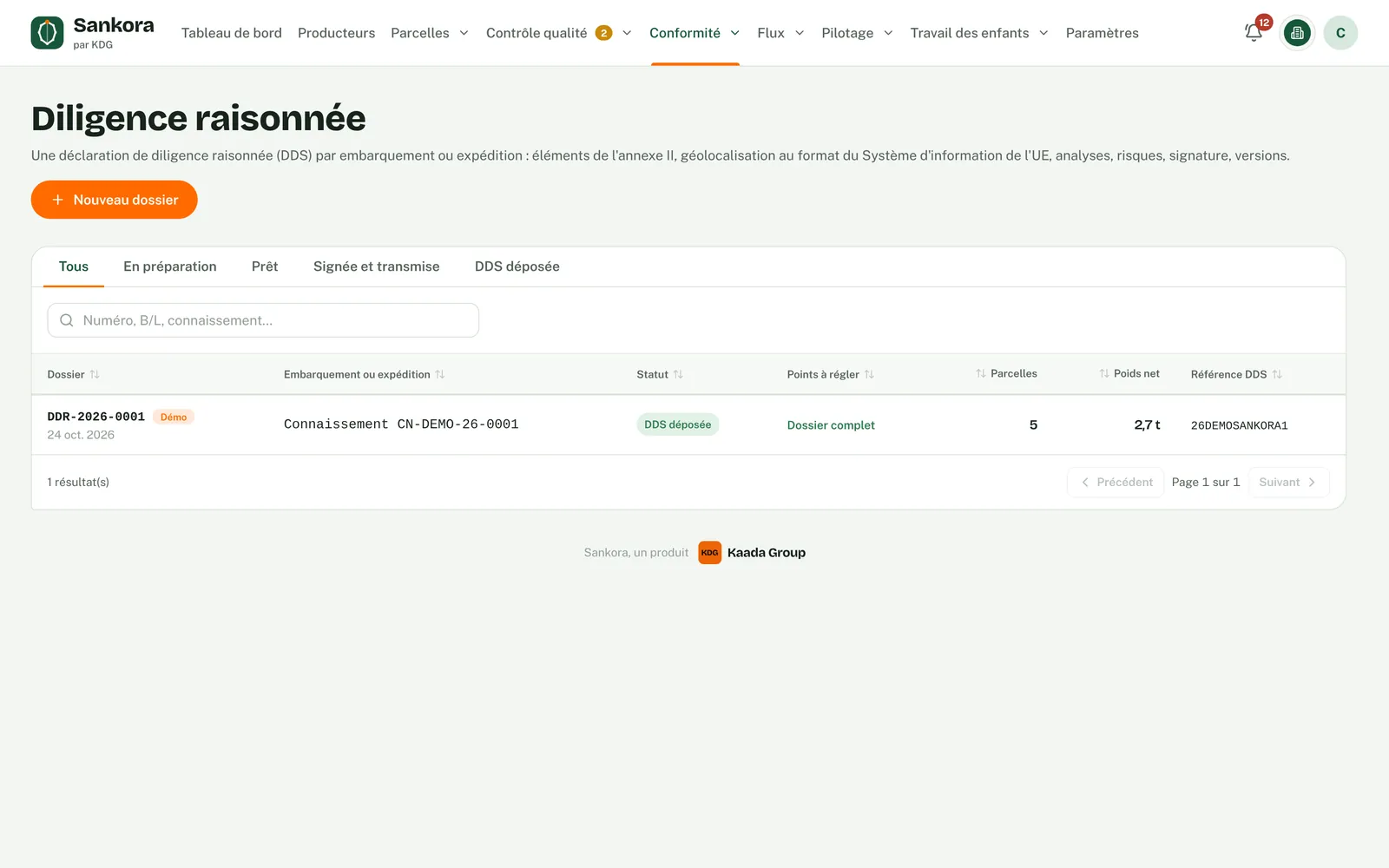
For deforestation, the starting point is plot geolocation, compared with forest cover maps and satellite images. These analyses identify areas at risk. They replace neither field verification nor the buyer’s due diligence. For products covered by the EU Deforestation Regulation (EUDR), the cut-off date is 31 December 2020.
Farming practices (agroforestry, shade trees, use of inputs) are monitored through visits and questionnaires repeated from one season to the next, rather than through a single survey.
Producer income
Buyers are interested in the income of producer households. This data (production, prices received, costs, other income) is self-reported, sensitive and varies from year to year. Collecting it must rely on an explicit method and a defined sample. Results are presented with their limitations. An income gap can only be calculated with a method and a benchmark recognised by the buyer.
Climate: the data your buyers need
For a buying company, emissions linked to the agricultural products it purchases fall under “Scope 3”: the emissions in its value chain, outside its own operations. To estimate them with actual data rather than averages, the buyer or its consultancy may need field information: areas, volumes, practices, fertiliser use, transport to the collection point.
Calculating emissions and validating any carbon credits are matters for specialised methods and bodies. Field data collection provides the input data. On its own, it does not produce a carbon footprint assessment.
Making data verifiable
A few rules make data usable by a buyer or an auditor:
- a stable ID for each producer, plot and lot;
- the date, author and method of each record;
- a history of corrections, with nothing deleted;
- consistency checks (areas, volumes, duplicates);
- documentation of the definitions used.
Sharing without giving everything away
A buyer does not need all your data. Agree with the buyer on what they receive, at what level of detail (producer, cooperative, area) and in what format. Personal and social data remains protected by the country’s data protection law: in Côte d'Ivoire, Law No. 2013-450. Small companies in the value chain also benefit from limits on information requests set by recent EU legislation.
How Kaada Group supports you
We design the questionnaires, organise the data collection, develop the tools and produce the reports that make your sustainability data verifiable and shareable with your buyers, certifiers and funders. Buyer requirements.
Sources
Reference sources, as of 11 October 2026.
- Regulation (EU) 2023/1115 (EUDR), EUR-Lex
- European Commission, corporate sustainability due diligence (CSDDD)
- European Commission, corporate sustainability reporting (CSRD)
- European Commission, forced labour regulation
- ARTCI, list of laws (in French)
- GHG Protocol, Corporate Value Chain (Scope 3) Standard
Up to date as of 11 October 2026. This article is general information, not legal advice.
Free assessment: a 45-minute conversation with a Kaada Group expert, by video call or in Abidjan.
Social: children, labour, grievances
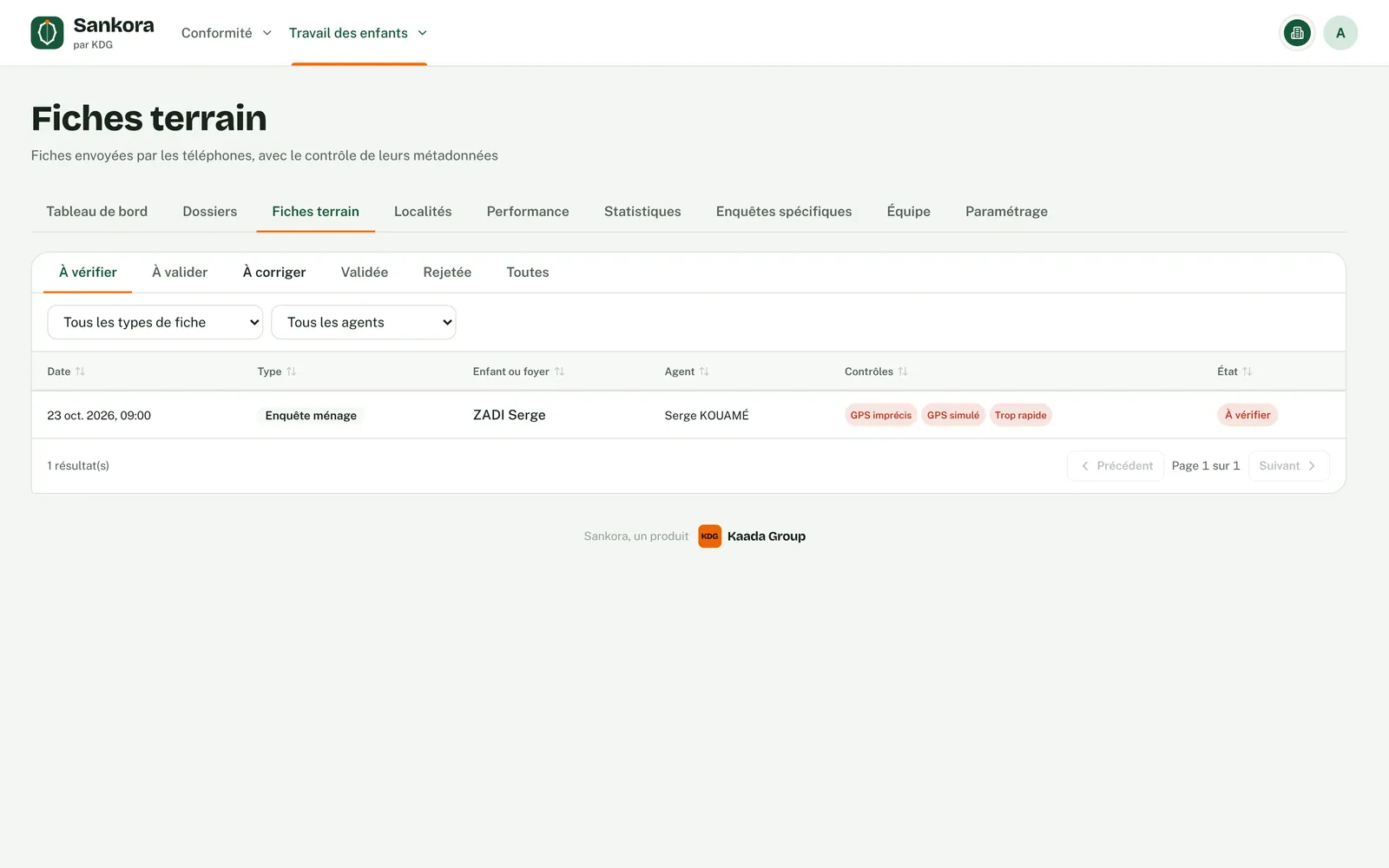
Social data is the most sensitive. Child labour monitoring relies on monitoring and remediation systems (CLMRS, Child Labour Monitoring and Remediation System): household visits, identification of cases, remediation actions followed through to closure. This data concerns minors. Access to it must be strictly limited, and it is only shared with a buyer in aggregated form.
Forced labour and working conditions are increasingly monitored, notably because the EU forced labour regulation will apply from 14 December 2027. A grievance procedure accessible to producers and workers is also among the expectations of large companies subject to due diligence obligations.