No market access without a statement
The operator placing the product on the EU market for the first time must submit a due diligence statement. Its suppliers must give it what it needs to prepare it.
Due diligence file
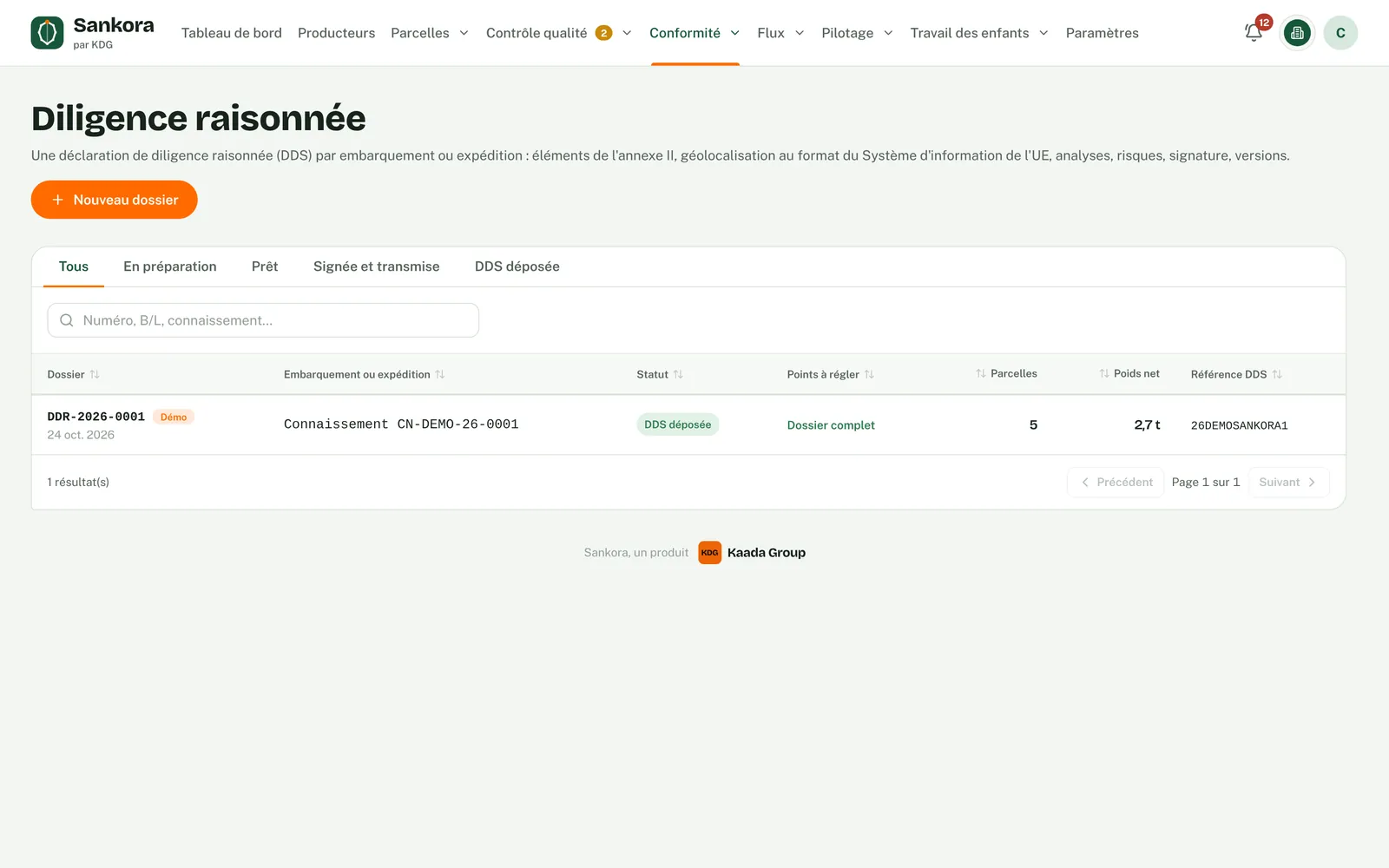
For each shipment, Sankora assembles the Annex II information and the evidence behind it. A second person signs, then you submit the statement in TRACES yourself and record the reference you receive.
The operator placing the product on the EU market for the first time must submit a due diligence statement. Its suppliers must give it what it needs to prepare it.
Geolocation, analyses, risk assessment, internal policies: gathering them by hand takes weeks. Every gap delays the shipment or weakens the statement.
The EU Information System expects a precise GeoJSON file, with at least six decimal places and polygons for plots over 4 hectares. Preparing it by hand invites errors.
Information must be kept for at least five years and found quickly during an inspection. You need to be able to show exactly what was declared.
A file is created for a vessel shipment (exporter) or a truck shipment (cooperative). Sankora automatically attaches the lots, the plots of origin and their analyses.
Sankora lists what is missing: operator details, HS code, analyses, a risk assessment covering each lot. Blocking items are kept apart from simple remarks.
The file brings together the statement (Annex II), GeoJSON in the EU Information System format, the plot list, analyses, the risk assessment, a PDF report and a fingerprint manifest. Each generation is kept as a version.
An authorised person signs on behalf of the organisation. Neither the person who generated the version nor those who entered the statement details can sign.
The signed file is shared with your customer, who finds it in their own space. The user submits the statement in TRACES themselves, then records the reference and verification number in Sankora.
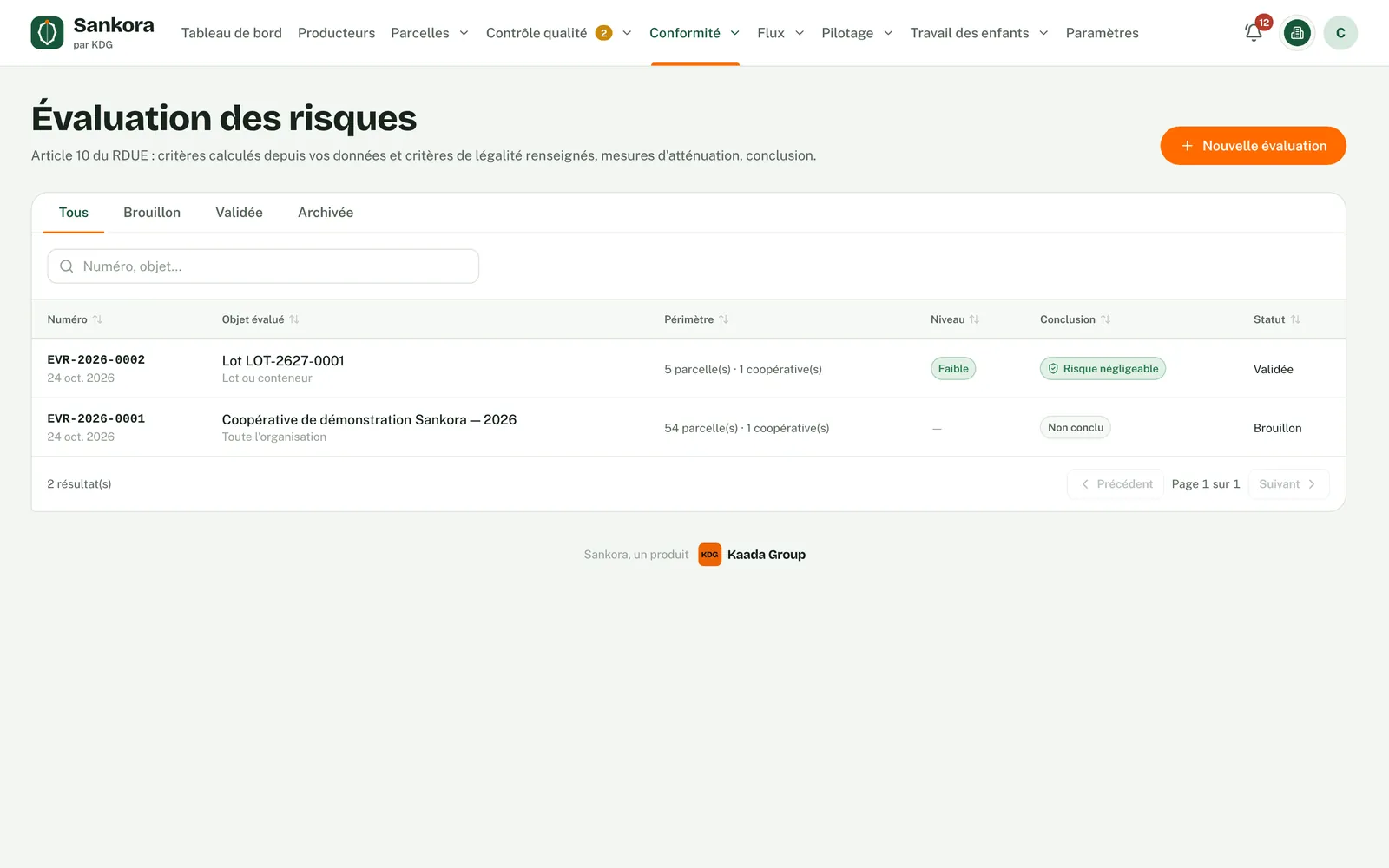
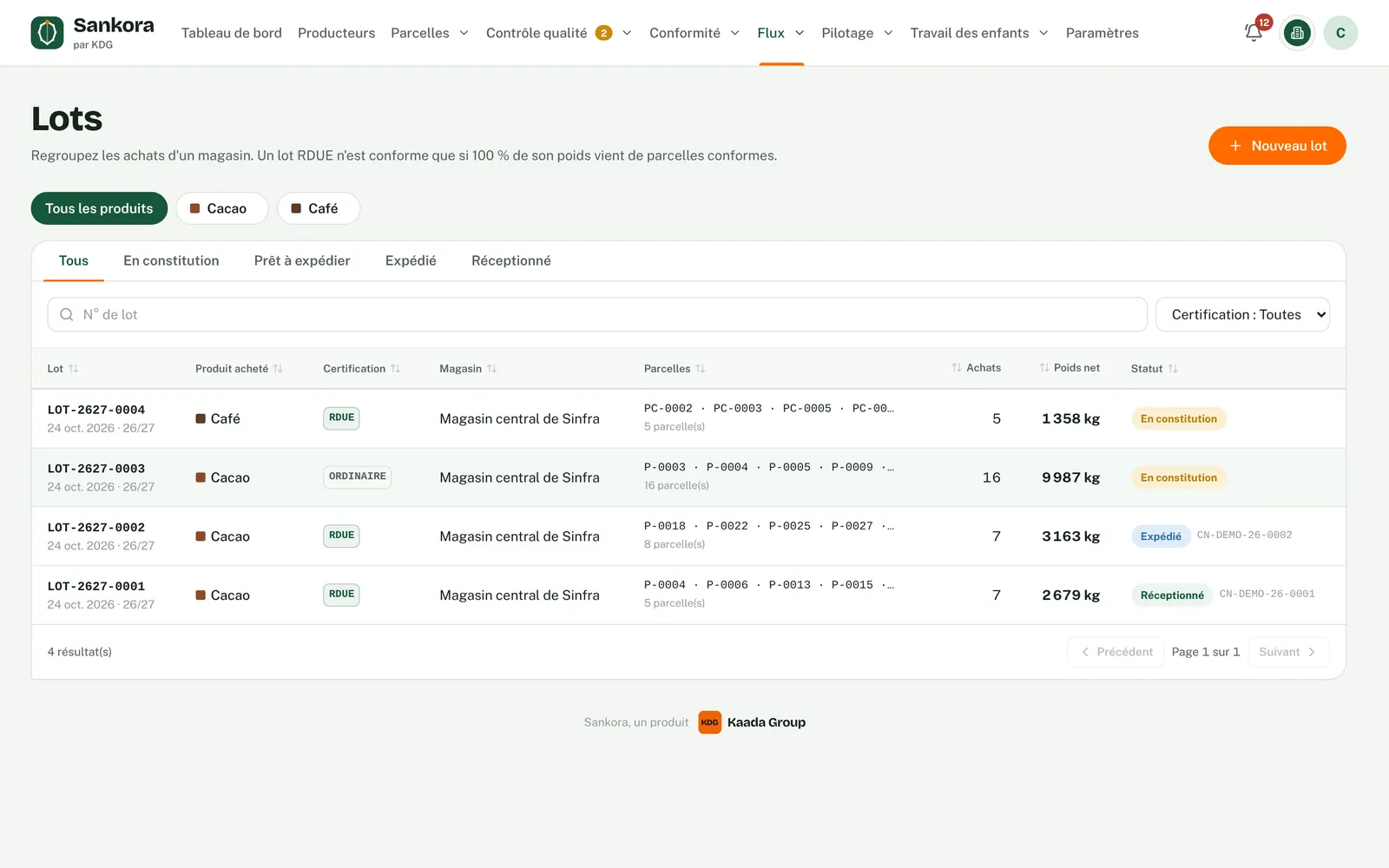
Real application screenshots · fictitious demo data
Prepare a file for each shipment and pass it to your exporter with all its evidence.
Produce the file for each vessel shipment from containers that are already traced and assessed.
Find the statement details, items to resolve and GeoJSON for the EU system in your own space, then record the reference of your statement there.
A complete, signed file for every shipment, ready for you to submit in TRACES.
No. Sankora prepares a complete statement. The user submits it in the EU Information System, then records the reference and verification number in Sankora.
That is the four-eyes rule: a second authorised person reviews and commits the organisation. Sankora enforces it automatically on every version.
The content fingerprint is recomputed before signature and before the reference is recorded. If plots, analyses or statement details have changed, a new version must be generated.
At least five years. Every generated, signed or submitted version stays downloadable with its fingerprint, and nothing is overwritten.