Every child identified, followed until they exit.
Data4Child is Sankora's child labour monitoring and remediation system (CLMRS). Your agents collect data in the field, even without network; every case is classified automatically, assigned to an agent and followed until the child has durably left work or risk.
- Secure offline Android collection
- Position of every form
- Agent targets and performance
- Automatic case classification
Buyers and sustainability programmes ask for evidence of child monitoring, not statements.
The EU regulation also requires production to comply with the country's legislation, labour law included.
Without a tool, paper forms get lost and identified cases are no longer followed.
From the household visit to the child's exit, nothing gets lost.
A form collected without network, a case classified in seconds, a child followed for months: this is how Data4Child supports your teams.
The agent fills in the survey in the household, offline. The form is signed by the phone and sent as soon as the network is back.
- Form signed by the phoneYes
- Start and end positionRecorded
- Simulated positionNot detected
- Required fieldsComplete
- SendingAutomatic when network returns
Answers are assessed by the questionnaire rules. The case is classified, action deadlines set, the agent notified.
- In schoolNo
- Reported tasksCarrying heavy loads, using a machete
- Hours during harvest28 h per week
- Child interviewCompleted
- Household awareness sessionwithin 1 month
- Support deliveredwithin 6 months
- Follow-up visitsuntil two negative visits
- Age and type of taskHazardous task
- Working hoursAbove threshold
- SchoolingRisk factor
- Case levelConfirmed
Every form carries its position. The manager sees where and when agents collected data, and measures their progress against their targets.
- Farmers covered71% · 64 / 90
- Pace needed3 visits a day
- Today's forms9 · positions checked
- Form outside area1 to review
- Follow-ups on time93%
Awareness, support, follow-up visits: every step is dated, until the child's lasting exit.
- Oct 2026IdentificationHousehold survey and interview
- Nov 2026AwarenessHousehold and farmer
- Feb 2027Support deliveredSchool kit, birth certificate
- Apr 2027Follow-up 1Negative
- Jul 2027Follow-up 2Negative
- Jul 2028One-year checkStill out of work
Illustrative animation · sample data · rules and deadlines actually applied by Data4Child
Eight reasons to choose Data4Child.
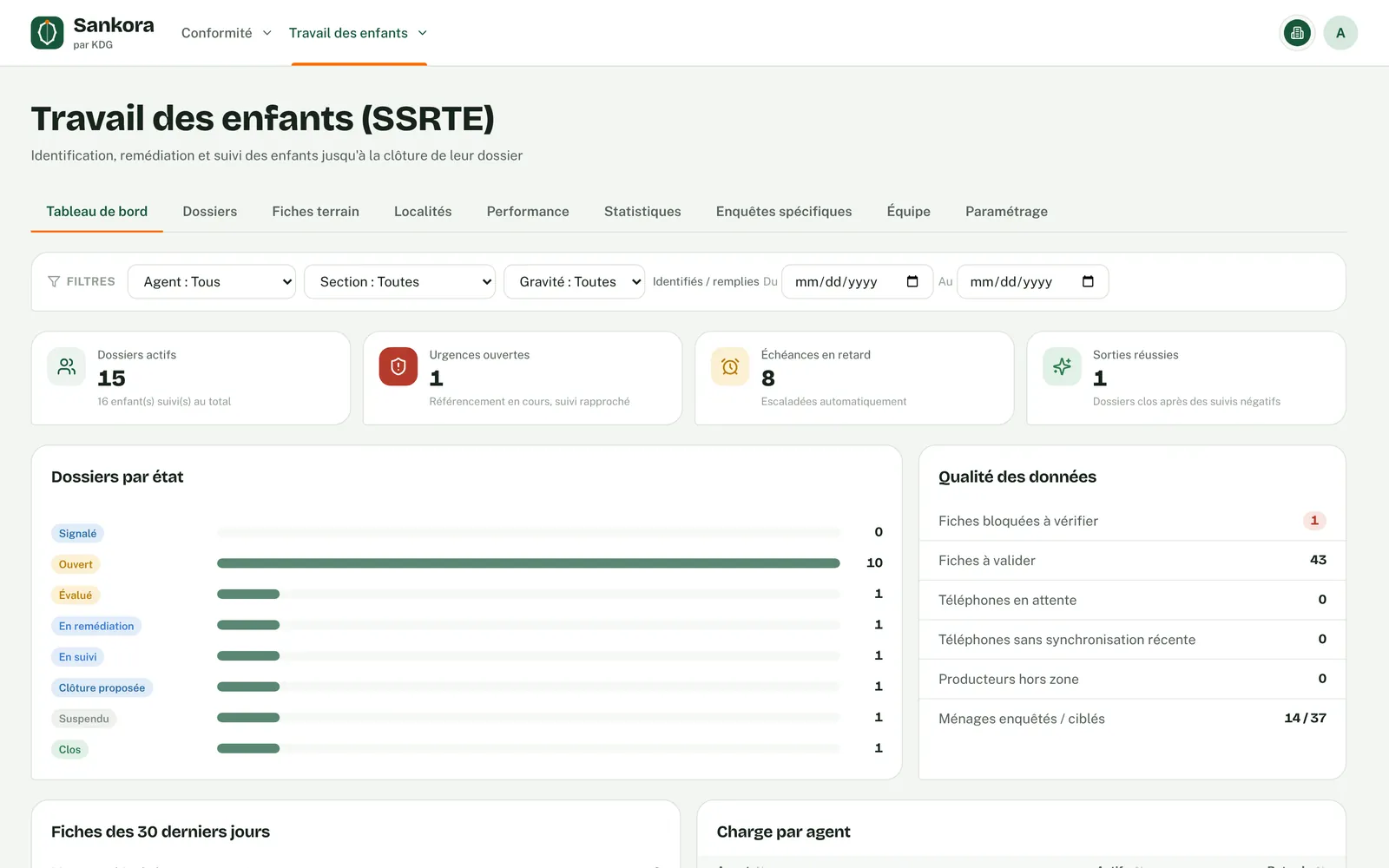
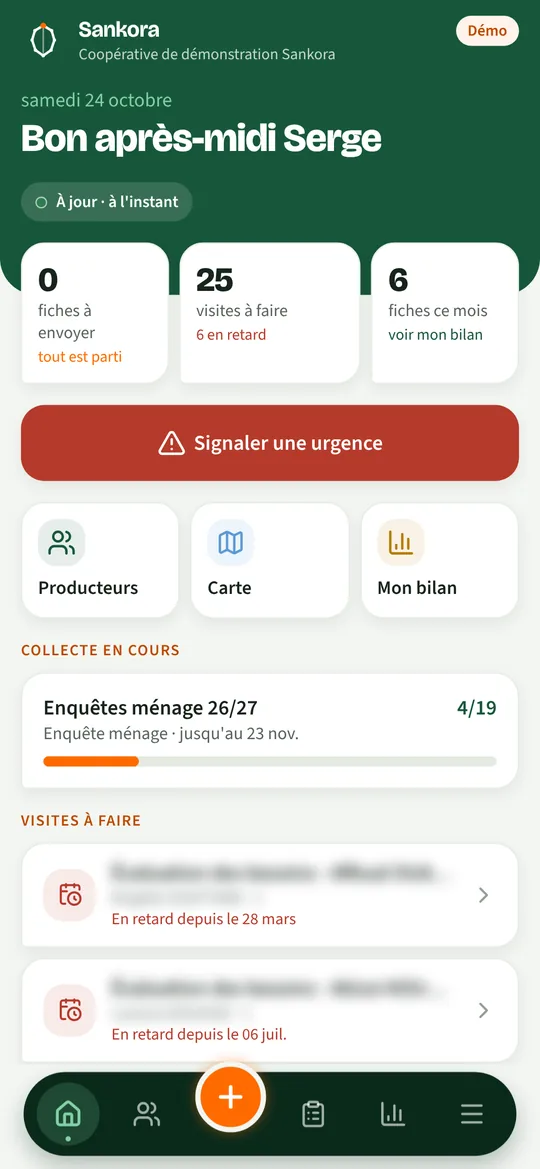
Each feature is shown with a real screen of the application.
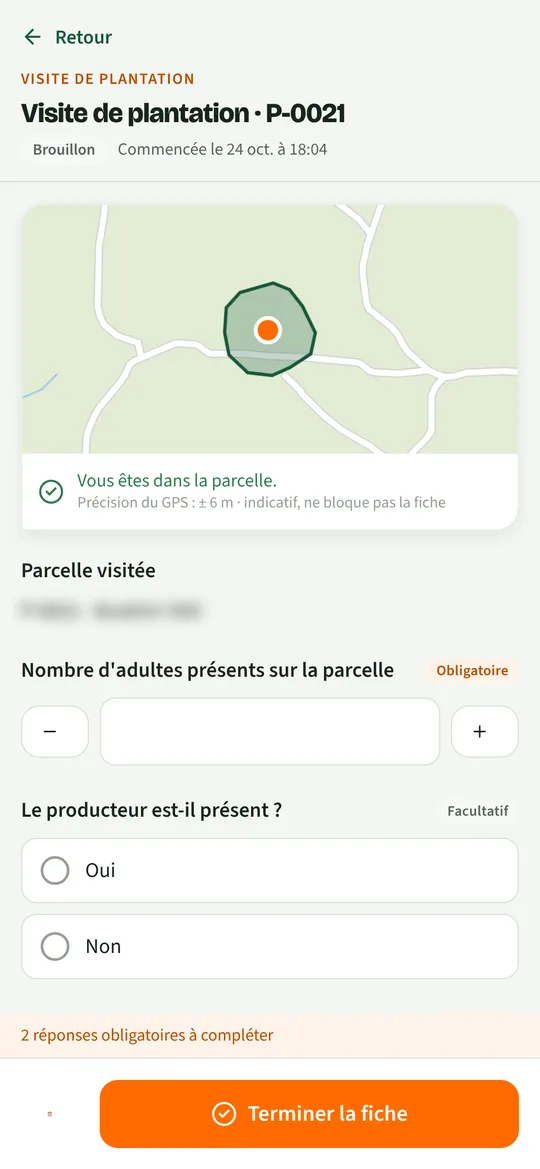
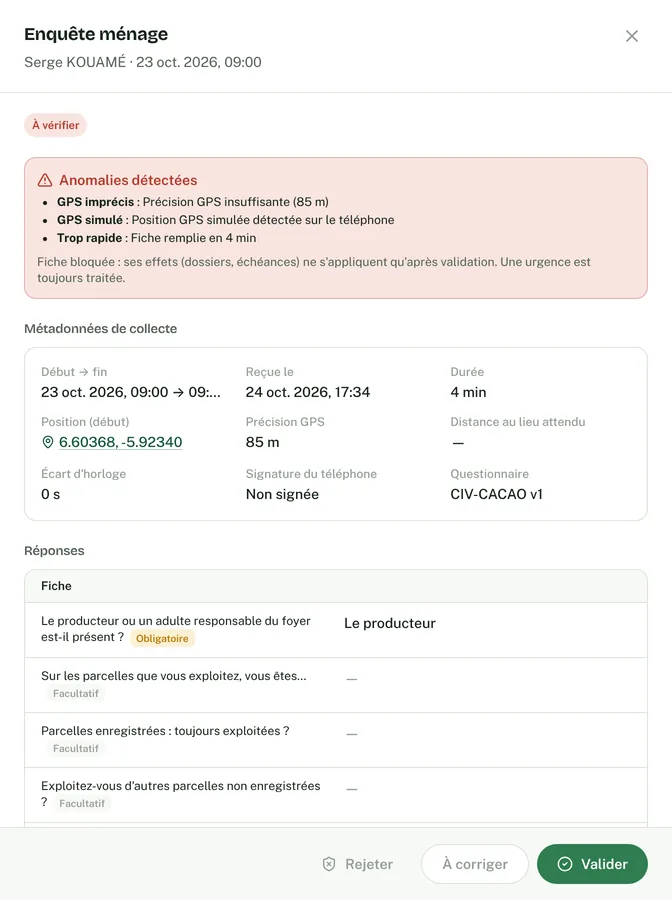
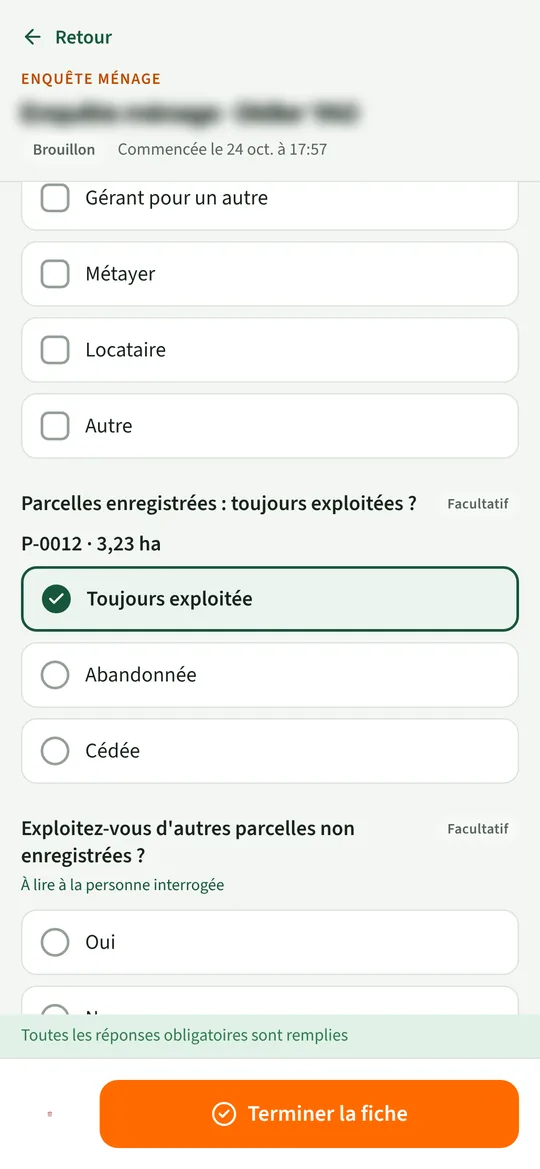
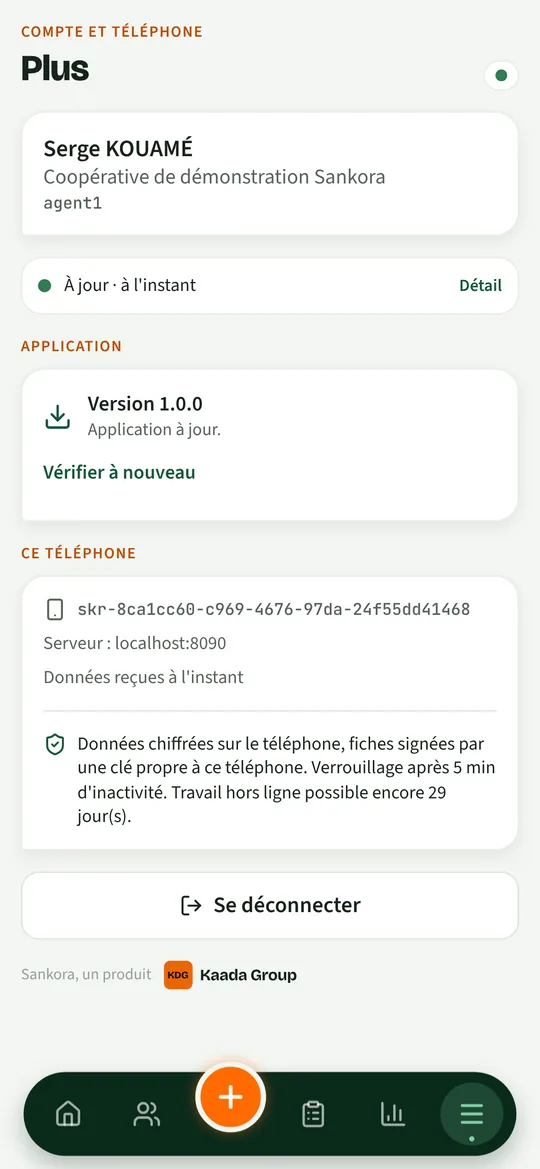
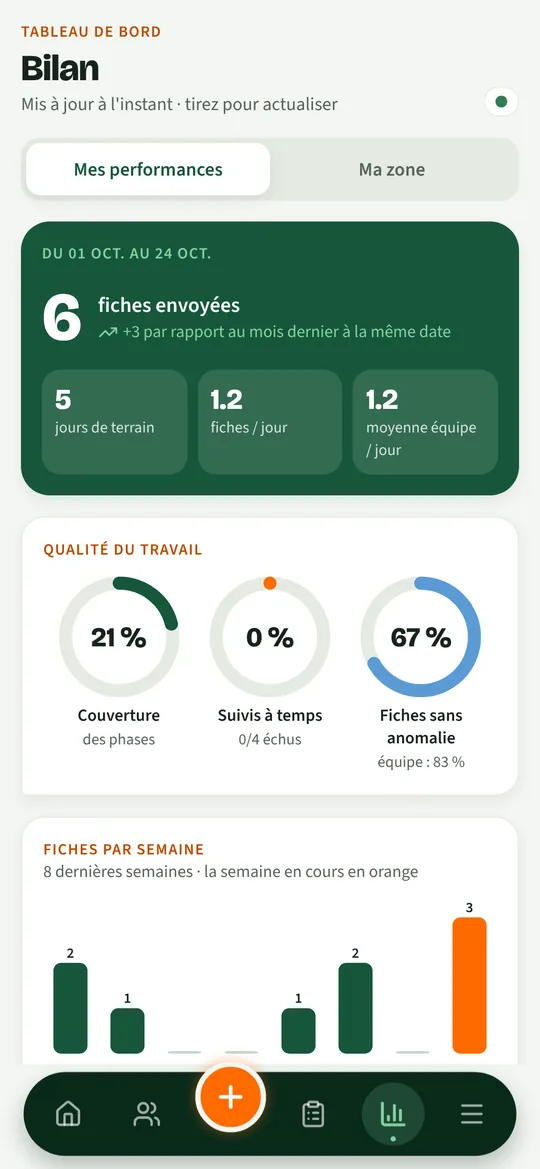
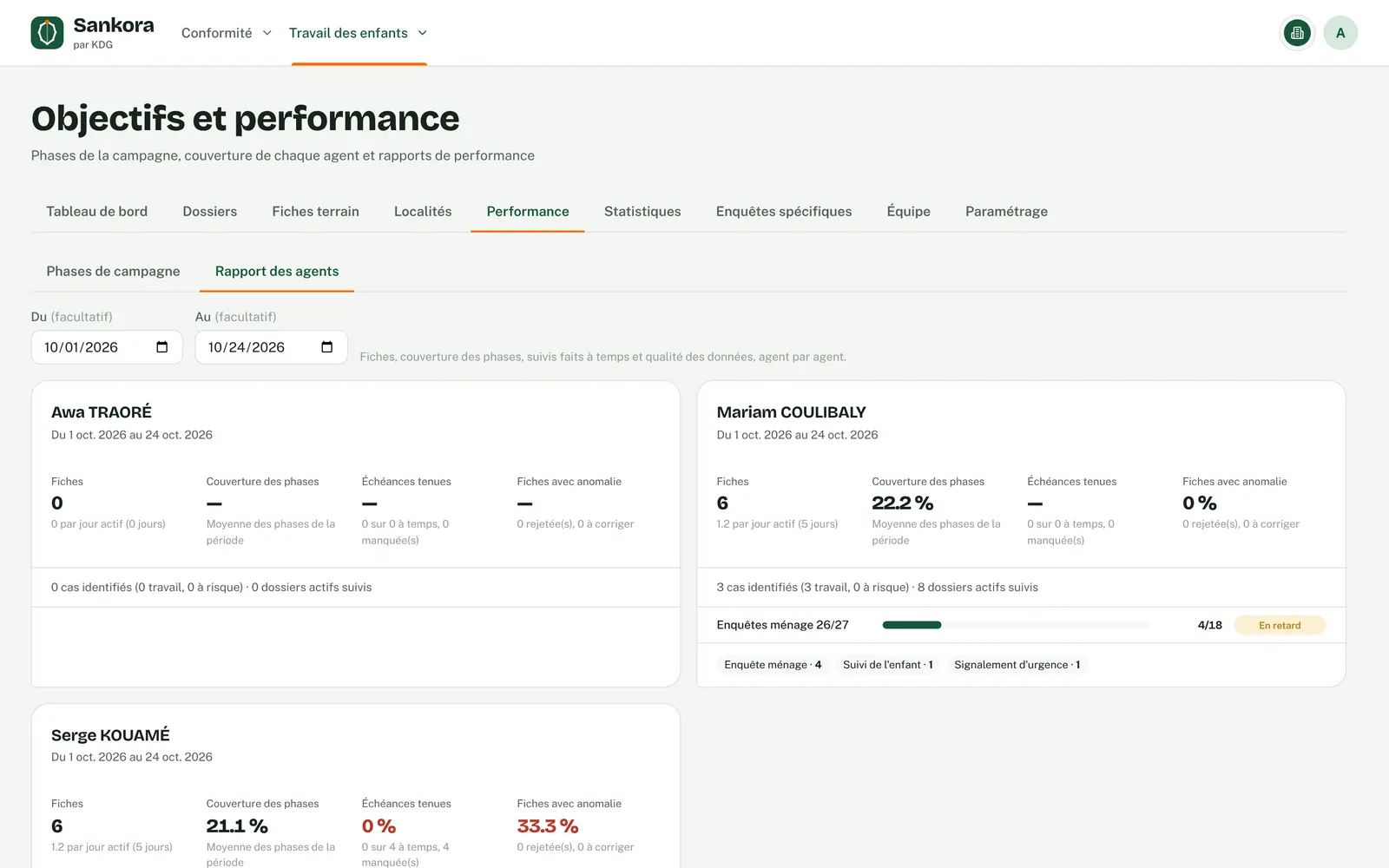
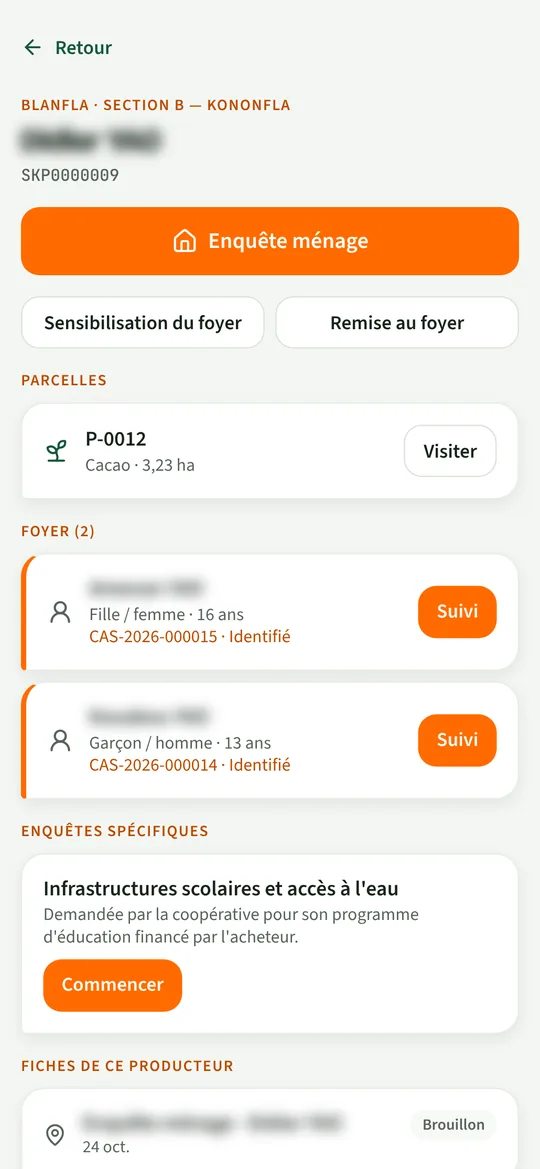
Real application screens · fictitious demo data · personal names hidden · map data © OpenStreetMap
A Data4Child form is evidence.
Who collected it, where, when, on which phone: every form carries its guarantees, checked by the platform on receipt.
Collection position
Position recorded at the start and end of every form, compared with the agent's assigned area.
Simulated positions detected
Apps that fake the position are detected and the form is flagged.
Signed by the phone
Every form is signed with a key unique to the phone: it cannot be altered without the platform noticing.
Registered phones
The phone identifier (IMEI) is declared, then approved by the manager before any data is sent.
Required fields
An incomplete form is not sent: the answers used to classify the child are mandatory.
One agent, their farmers
Each agent sees only the farmers in their area; another agent can sign in only once the previous agent's forms are sent.
Set targets, follow the field, assess on facts.
The CLMRS manager organises the season, assigns targets and measures each agent's performance from the forms actually collected.
Assigned targets
The season is split into dated phases. In each phase, the agent's target is to cover all of their farmers.
Pace recalculated
Every day, Data4Child works out the number of visits needed from what remains and the time available.
Collection map
The positions of each agent's forms appear on the map of their area: actual visits, routes, gaps.
Performance reports
Coverage, pace, forms to review, follow-up deadlines met: one report per agent, frozen at the end of each phase.
Controlled extensions
A phase ends on its date for the whole team; the manager can extend it for a specific agent.
Two role levels
The manager sees all statistics and all agents; each agent sees their own dashboard and farmers.
A complete method, from the community to the child.
Data4Child follows the steps of a monitoring and remediation system: each step has its form, its agent and its deadline.
- 01
Community profile
A profile of each community, at the start of the season.
- 02
Awareness
Sessions in the localities assigned to each agent.
- 03
Household survey
Identification of working children or children at risk.
- 04
Child interview
Triggered by the survey, the child is registered with their household.
- 05
Plantation visit
Observation of working conditions on the plot.
- 06
Remediation
Support for the child, the household or the community.
- 07
Follow-up
Visits until exit, then a one-year check.
The right action, at the right time.
Every case is classified automatically by the core questionnaire rules. The level sets the pathway and the deadlines, which Data4Child monitors for you.
- Immediate risk: emergency report and action within 24 hours
- Confirmed child labour: awareness within 1 month, support within 6 months, follow-ups until two negative visits
- Child at risk: awareness within 3 months, support within 1 year
- Nothing to report: reassessment within 1 to 2 years
- Support for the child, the household or the community, with proof of delivery
A common core, adapted to each cooperative.
Kaada Group provides the core questionnaires and their classification rules. Each cooperative can add its own questions, but never remove those that identify children.
- Eight clearly named forms, from the community profile to the emergency report
- Questions added by the cooperative: information only, no effect on classification
- New core questionnaire versions applied from a set date, for new forms
- Managers notified before every change
Guided agents, measured coverage.
The CLMRS manager splits the season into dated phases. Each agent sees their farmers, their progress and the pace needed to cover their whole area.
- Farmers assigned by area: each agent sees only their own
- Target per phase: cover all of the agent's farmers
- Daily or weekly pace recalculated from what remains
- Performance reports frozen at the end of each phase
Useful figures, without exposing children.
The cooperative has the named detail it needs to act. Its partners receive anonymous statistics, hidden when counts are too small.
- Households covered, children identified, children supported, successful exits
- Follow-up deadlines met and share of children still out after one year
- Named detail restricted to the CLMRS manager and management
- Detail shared with an exporter only if the cooperative turns it on
The cooperative, or its exporter.
One operator per cooperative, to avoid duplicate visits in the field.
The cooperative runs it
It takes the module and runs the season with its own agents. Its partner exporter always sees the overall statistics; named detail is shared only if the cooperative turns it on.
The exporter runs it for its cooperatives
When a cooperative has no system, the exporter deploys its own agents in its partner cooperatives and manages the whole programme.
Children's data handled with the utmost care.
Data4Child applies strict rules, on the phone as on the platform.
Locked phones
Encrypted local database, unlock code, remote wipe if lost or stolen.
Authenticated forms
Every form is signed by the registered phone that produced it, with its collection position.
Restricted access
Children's names are visible only to the CLMRS manager and the organisation's management.
Nothing left behind
Photos and signatures are removed from the phone as soon as their upload is confirmed.
Data4Child builds on Sankora.
Households, farmers and plots come from the Sankora register: nothing is re-keyed, and your EUDR compliance files can draw on your child labour monitoring.
What we are asked most often.
Do you need an internet connection in the field?
Can the questionnaire be adapted?
Who sees children's data?
Which phones are needed?
Does Data4Child work without Sankora?
How is Data4Child priced?
See Data4Child on your own cases.
Fill in this form: we will get back to you within one business day to schedule a 45-minute demo, online or in Abidjan.
- Free and with no commitment
- Tailored to your commodity and your role
- Reply within one business day
Protect the children in your supply chain.
A 45-minute demo with a CLMRS specialist from our team. Free and with no commitment.